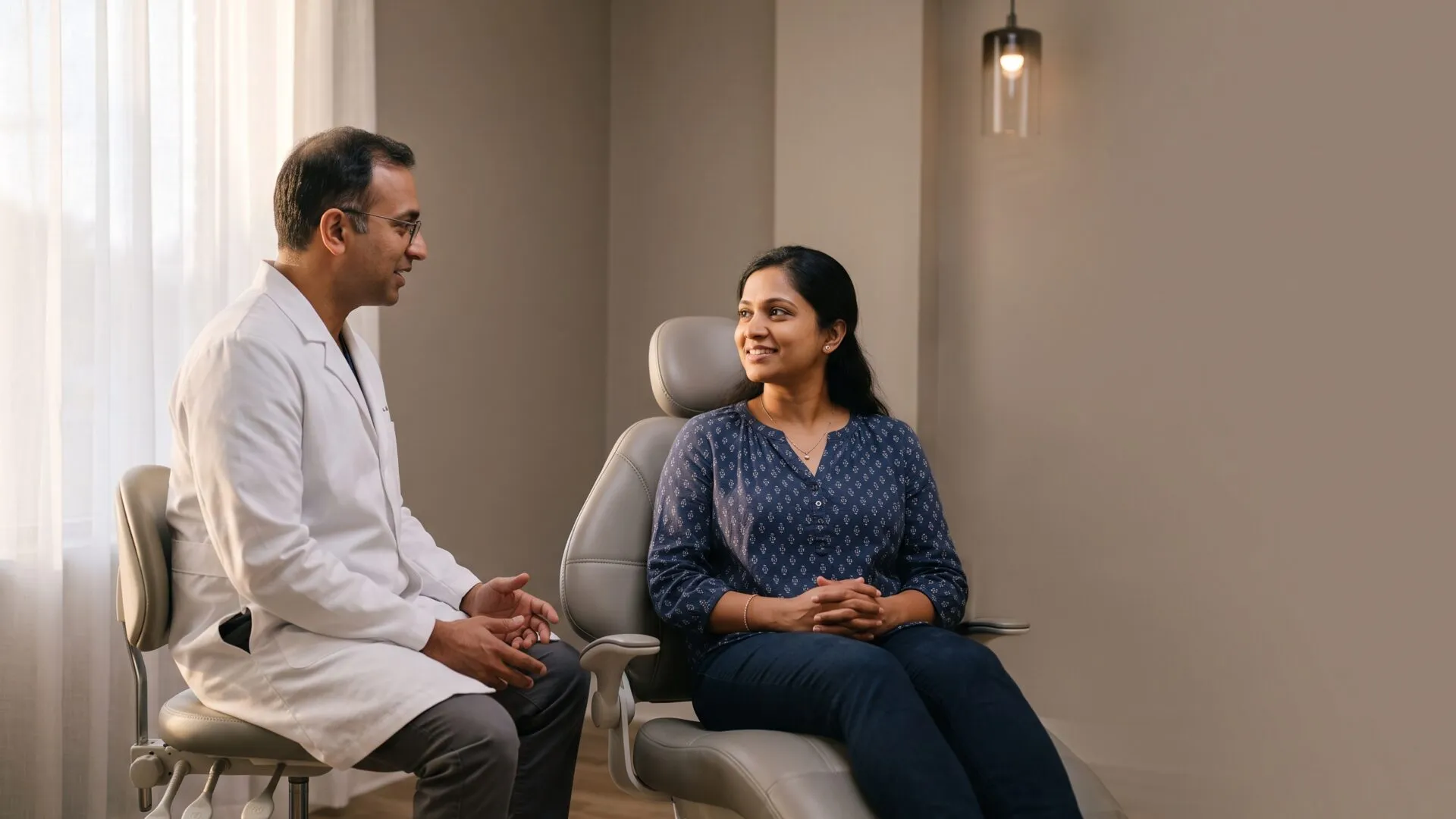
Ask anyone in Lahore who treats a heart problem and you will hear "cardiologist" without hesitation. Kidneys, a nephrologist. Skin, a dermatologist. Nobody finds this confusing, and nobody takes it as an insult to their family doctor. Now ask the same person who should treat an infected molar, a deeply impacted wisdom tooth and a bite that has never closed properly. The answer is almost always the same three words: my dentist. One person, one chair, everything.
This article is about that assumption — where it comes from, why it is usually harmless, and the specific situations in which it quietly costs patients teeth.
This is not an argument that general dentists are unqualified, or that every dental problem needs a specialist. Most dental care in Pakistan is provided by general dentists, and most of it should be. The argument is narrower and, we think, more useful: asking whether a dentist is allowed to do a procedure is the wrong question. The question is whether the right clinician is treating the right case, with training that matches its difficulty.
Because here is the part almost no Pakistani patient knows: under Pakistani law, the answer to "is my dentist allowed to do this?" is essentially always yes.
Why do Pakistani patients expect one dentist to do everything?
Because nothing in public life has ever told them otherwise. Pakistani patients are not careless about their teeth. They were never given the information that there was anything to think about.
Medical specialisation is visible here. Hospitals have cardiology departments. Referral letters exist. People say "I am seeing a neurologist" and everyone understands. Dentistry has almost none of that public scaffolding. A board says Dental Clinic, or daant ka doctor, and that is the entire briefing a patient receives before sitting down.
Several things keep the assumption in place:
- Dental specialties are invisible in daily life. No public campaign, no television segment, no school lesson has ever explained what a periodontist is. Most people have never heard the word.
- Clinic signage does not distinguish. Most dental clinics present themselves simply as "dentists" — accurate, but it flattens a real difference in training.
- Patients reasonably assume all dentists trained identically. All dentists did share a BDS. What differs is what came after it, and that part is invisible from the waiting room.
- Trust transfers. The dentist who did an excellent filling is trusted with a decision about jaw surgery. That is not foolishness; it is how humans work.
- Convenience and cost are genuine constraints. Where most dental care is paid out of pocket, choosing the nearby clinic is arithmetic, not laziness.
- Nobody tells the patient the case is difficult. This is the heart of it. A patient cannot ask for a second set of eyes on a case they have not been told is complicated.
None of this is a failure of patients, and none of it is an accusation against Pakistani general dentists, the great majority of whom refer appropriately and do excellent everyday work. It is a gap in public information, and this article is an attempt to close it.
What does Pakistani law actually allow a dentist to do?
In short: Pakistani law places no procedure-by-procedure restriction on registered dentists. What it does control is who may call themselves a specialist — not who may do the treatment.
Most of what circulates online about what dentists "can" and "cannot" do is imported from Britain or America and simply does not describe Pakistan. So it is worth reading the Pakistani rule in its own words, once, in plain language.
The Pakistan Medical and Dental Council Act, 2022 took effect on 16 January 2023. Section 42, which lists what registration entitles a practitioner to do, says a full registration holder "shall be competent to practice medicine or dentistry and prescribe allopathic medicine and perform any surgical or interventional procedure on any patient".
Your dentist's licence carries the same logic on its face. The permanent registration certificate in the Council's Registration Regulations 2023 authorises the holder to treat "all ordinarily recognized common dental ailments and as permissible under section 42".
So a general dentist performing a root canal, an extraction or braces in Pakistan is doing nothing improper. Anyone who tells you otherwise is wrong, and it is reasonable to discount the rest of what they tell you.
Where does the law draw its line?
The very next sentence on that same licence is the one nobody quotes: "The license holder shall not represent himself/herself as a specialist/consultant or practice as a specialist until his/her postgraduate qualification in the relevant field is registered by the Council."
Section 43(2) of the Act extends the same principle to advertising: no registered person may publish any title, description or symbol suggesting they hold a qualification that has not actually been conferred and recognised. And the Council's regulations define the word precisely — a "specialist" is the holder of a registerable additional dental qualification in a particular field.
Two words there matter more than they look: registerable, and registered. Holding a postgraduate degree and having it registered with the Pakistan Medical & Dental Council are different things. The Council publishes a dated list of the postgraduate qualifications and training programmes it recognises, and warns publicly about unrecognised programmes. A degree that is not on that list cannot be registered — and an unregistered qualification does not entitle anyone to the word "specialist".
So the Pakistani position, in one small table:
| Regulated by law? | |
|---|---|
| Performing a dental procedure | No — permitted on full registration |
| Calling yourself a specialist or consultant | Yes — only once the postgraduate qualification is registered |
| Advertising a qualification you do not hold | Yes — prohibited outright |
Which leaves everything clinically interesting outside the law's reach. And that is exactly why patients need a better question than "are you allowed to?"
Legal scope, training or competence — what is actually being confused?
In short: what the law permits, what a qualification certifies and what an individual clinician can do well today are three different things. This whole subject becomes clear the moment you stop treating it as one question and start seeing seven:
- Legal scope — what the law permits. In Pakistan, essentially everything. It sets the outer boundary and nothing else.
- General dental qualification — the BDS, plus registration with the Pakistan Medical & Dental Council. This is a real, substantial qualification covering diagnosis, prevention, fillings, cleanings, extractions, many root canals, crowns and children's routine care.
- Specialist qualification — several years of structured, supervised postgraduate training in one defined field, examined nationally. FCPS, MDS, MSc, MPhil, MCPS or a recognised diploma. Not a weekend course.
- Individual competence — what a specific person can actually do well today. A general dentist who has spent fifteen years doing molar root canals under magnification may be more competent at them than someone freshly qualified in a different specialty.
- Experience — volume and variety in this particular procedure. This is why "how often do you do this?" is a better question than most patients realise, and it is answerable in Lahore even where a specialist register is not.
- Case complexity — the single most decisive factor, and the one a patient cannot assess alone. The same procedure name can describe two completely different jobs.
- Appropriate referral — recognising when a case belongs somewhere else, or when several clinicians should plan one mouth together.
Numbers 1 and 3 are what people argue about. Numbers 4, 5 and 6 are what actually decide whether treatment goes well.
An honest summary: specialist training raises the floor, not the ceiling. It does not mean a non-specialist cannot do the work well. It means that when a case goes sideways — and complex cases do — the specialist has seen that particular kind of sideways many times before.
Is it wrong for a dentist to treat something outside their specialty?
In short: Not necessarily. A dentist may appropriately treat outside a narrowly defined specialty depending on their training, experience, equipment and the difficulty of the individual case. A straightforward root canal or a simple alignment case can be entirely appropriate general practice. What matters is whether this clinician suits this case — and whether they would say so if not.
Most writing on this subject falls off one side of the horse or the other: either specialties are dismissed as marketing, or patients are told only specialists may touch them. Both are wrong, and the second one is the more expensive error, because it sends people chasing referrals they do not need and makes them distrust perfectly good dentists.
Worked example: is every root canal the same job?
A single-canal front tooth, straight root, clear diagnosis, no previous treatment — that is routine work, and a competent general dentist doing it carefully is entirely appropriate care. It happens well, every day, across Pakistan.
The picture changes when a case carries any of these features:
- unusual or sharply curved root anatomy, or extra canals
- canals narrowed by calcification and hard to locate
- difficult access — limited mouth opening, a heavily crowned tooth, a far-back molar
- a tooth that has already had a root canal and still hurts (retreatment)
- a fractured instrument left inside a canal
- a perforation of the root or the floor of the pulp chamber
- infection or swelling that keeps returning after treatment
- a diagnosis that does not add up — pain that does not match the X-ray
There is good evidence behind this, and it is more interesting than "specialists are better". A 2025 prospective study from the US National Dental Practice-Based Research Network — the PREDICT project, published in the International Endodontic Journal — followed 1,698 root canal treatments carried out by 153 clinicians: 104 general dentists and 49 endodontists.
The endodontists were treating measurably harder cases — a mean of 2.24 difficulty factors per case against 1.47 — and still had fewer complications: 13% compared with 19%.
Read that carefully, because it is easy to misread. It is not evidence that endodontists are better dentists than general dentists. It is evidence about matching: the general dentists in that study were sending the difficult cases onward, the specialists were absorbing them, and outcomes held up on both sides of that handover. That is a referral system working as designed — and it is the strongest argument in this article for why referral matters, made without disparaging anyone.
It is worth knowing that the tool clinicians use to make that call — the American Association of Endodontists' Case Difficulty Assessment Form, which grades a case as minimal, moderate or high difficulty before treatment begins — was designed for general dentists. Referral is built into the profession's own tooling. It was never intended as an admission of defeat.
Worked example: when does orthodontics need a specialist?
Mild crowding of the front teeth in an adult with a stable, healthy bite sits at the simple end of orthodontics, and treatment by a non-specialist with genuine orthodontic training can be perfectly appropriate.
An orthodontist's assessment becomes worth seeking when the case involves significant malocclusion — deep bite, open bite, crossbite, underbite; skeletal discrepancies, where the problem is the jaws rather than the teeth; growing children, where timing changes what is achievable; impacted or congenitally missing teeth that must be brought into position; orthodontics combined with surgery, implants or extensive restorative work; or any plan involving the extraction of healthy teeth.
That last point deserves weight. Extraction decisions in orthodontics are permanent, and they are precisely the sort of judgement that years of specialist training exist to inform.
Orthodontists make a point about their own field that is worth borrowing: moving teeth is the straightforward part. Deciding where they should end up, whether the bite will be stable, whether to extract, and how to hold the result — that is the specialty. The American Association of Orthodontists' concern about direct-to-consumer aligners is really about this: treatment should follow an in-person examination with proper records and radiographs, because gum disease and root problems are invisible in a photograph.
The same principle carries across every specialty. The existence of a specialty does not mean every case belongs to that specialist. It means the training exists for a reason, and patients deserve to know when that reason applies to them.
What makes a dental case complex?
In short: A case is complex when the diagnosis is uncertain, when anatomy is difficult or close to nerves and sinuses, when previous treatment has failed, when several problems interact, when a child or a medical condition changes the risk, or when the plan is hard to reverse. Complexity is a property of the case, not a judgement about the patient.
You will not be able to assess most of these yourself, and you do not need to. The point of knowing them is to recognise when it is sensible to ask: "Is this straightforward or complicated, and what makes it so?"
Flags a patient can genuinely notice:
- It has been treated before and it is still a problem. Retreatment is generally more complex than first-time treatment.
- The diagnosis keeps changing, or nobody can say clearly which tooth is causing the pain.
- Something has persisted for more than about two weeks without explanation — an ulcer, a lump, a patch, a numb area.
- Several things are wrong at once — gum disease and missing teeth and a collapsed bite. These interact, and treating them in the wrong order wastes the work.
- The plan is difficult to undo — extractions, implants, crowns on many teeth, jaw surgery. Reversibility is an underrated measure of risk.
- The patient is a young child, or has a medical condition that may change how treatment is planned — bleeding disorders, uncontrolled diabetes, blood-thinners or bisphosphonates, cardiac history, pregnancy. None of these makes dental treatment impossible, and none of them automatically calls for a specialist. They are situations where, depending on the procedure and the individual, the plan may need extra assessment, modification, added precautions or coordination with your doctor.
- No full record has been taken. A plan for major work built on a glance and one small X-ray is built on very little.
Which dental specialties exist in Pakistan?
In short: The College of Physicians and Surgeons Pakistan runs fellowship training in six dental specialties: Oral and Maxillofacial Surgery, Orthodontics, Periodontology, Prosthodontics, Operative Dentistry & Endodontics, and Paediatric Dentistry. Pakistani universities additionally award MDS, MSc and MPhil qualifications in these fields and in oral medicine, oral pathology and oral biology.
One fact makes the scale of the awareness gap obvious. CPSP lists 48 primary FCPS specialties across all of medicine and dentistry. Six of them are dental. A patient who has learned to tell a cardiologist from a nephrologist has usually learned to tell apart none of the dental ones.
| Specialist | Concerned with | Pakistani qualification route |
|---|---|---|
| Orthodontist | Tooth position, the bite, jaw relationships, growth and development, retention of the result | FCPS (Orthodontics); MDS or MSc Orthodontics; MCPS; recognised diploma |
| Endodontist | The inside of the tooth — pulp, root canals, diagnosis of dental pain, retreatment, root-end surgery | FCPS (Operative Dentistry & Endodontics); MDS or MSc Operative Dentistry; MCPS; recognised diploma |
| Periodontist | Gums, periodontal ligament and the bone that holds teeth in place; gum surgery; tissue around implants | FCPS (Periodontology); MDS or MSc Periodontology; MCPS; recognised diploma |
| Oral & maxillofacial surgeon | Surgery of the mouth, jaws and face — impacted teeth, jaw pathology, cysts, trauma, jaw surgery | FCPS (Oral and Maxillo-Facial Surgery); MDS or MSc Oral Surgery; MCPS |
| Prosthodontist | Replacing and rebuilding teeth — complex crowns and bridges, dentures, full-mouth rehabilitation, implant restoration | FCPS (Prosthodontics); MDS or MSc Prosthodontics; MCPS; recognised diploma |
| Paediatric dentist | Dental care of children, including very young children, developing teeth, behaviour management, special needs | FCPS (Paediatric Dentistry); MDS Paediatric Dentistry; recognised diploma in paedodontics |
| Oral medicine / oral pathology | Diagnosis of diseases of the oral tissues — persistent ulcers, patches, lumps, oral signs of systemic disease | MSc Oral Medicine; MDS or MPhil Oral Pathology; MPhil Oral Medicine |
Three details specific to Pakistan, which trip up patients who have read American websites:
- There is no qualification called "Endodontics" on its own in Pakistan. The fellowship is Operative Dentistry & Endodontics, and the university route is MDS or MSc Operative Dentistry. A Pakistani endodontist's credentials will read that way. Judging the CV against a US specialty list will mislead you.
- Oral medicine and oral pathology are not among the CPSP dental fellowships. They are reached through MSc, MDS or MPhil. Different-looking credential, real qualification.
- Not every dental college offers every specialty. The Council recognises specific programmes at specific institutions, and publishes that list. Which is exactly why the useful question is about the individual clinician and their programme, not about the alphabet after their name.
One more distinction worth holding on to. The Pakistan Dental Association (PDA), the Pakistan Association of Orthodontists and the Pakistan Association of Oral and Maxillofacial Surgeons are professional associations. Membership indicates engagement with a field. It is not a licence and not a qualification. Only registration with the Pakistan Medical & Dental Council is.
What does an orthodontist do, and when do you need one?
An orthodontist is the dental specialist trained in the position of the teeth and jaws — diagnosing malocclusion, planning how teeth should move, and holding the result once they have.
Orthodontics is not "straightening teeth". It is working out what a correct bite looks like for a particular face and jaw, whether it can be reached by moving teeth alone, whether growth will help or hinder, and how to prevent relapse. Braces and clear aligners are only the instruments; what decides the outcome is the plan behind them.
Worth seeing an orthodontist when: the bite is genuinely wrong rather than just the front teeth; there is an underbite, deep bite, open bite or crossbite; a child has a developing jaw discrepancy; teeth are impacted or missing; earlier orthodontic treatment has relapsed; or the plan involves extracting healthy teeth.
Retention is not an optional extra. Teeth move for the rest of your life. Any orthodontic plan without a clear answer about retainers — which type, for how long, and who checks them — is an unfinished plan, whoever is providing it.
What does an endodontist do, and when do you need one?
An endodontist is the dental specialist concerned with the pulp inside the tooth and the tissues around the root — root canal treatment, endodontic diagnosis, retreatment of failed root canals, and root-end surgery. In Pakistan the qualification is normally FCPS Operative Dentistry & Endodontics, or an MDS or MSc in operative dentistry.
The specialty exists largely for two reasons: difficult diagnosis and difficult anatomy. Working out which tooth is generating pain that radiates across a jaw is a skill in its own right, and molar roots can carry canals that curve, branch, calcify or simply hide. That difficulty is also what a quote is really pricing, which is why what a root canal costs in Lahore, and what changes the figure is worth reading before you compare two of them.
Worth seeing an endodontist when: a previous root canal has failed or the tooth still hurts; the tooth is a molar with complicated anatomy; canals are calcified; an instrument has separated inside a canal; there is a perforation; infection or swelling keeps returning; or the real choice is between saving the tooth and extracting it, and you want the saving option assessed by someone who does that work daily.
There is also a question worth asking of anyone, anywhere, and it has nothing to do with job titles: "What technique and equipment will you use for this, and why?" Root canal treatment depends heavily on how it is done — how the tooth is isolated from saliva, how the canals are located and cleaned, whether magnification is used for difficult anatomy, and how the result is checked before the tooth is sealed. None of that is visible to a patient, and none of it is something you are expected to evaluate. Asking simply invites the clinician to explain their approach, which is a reasonable thing to hear before treatment begins — and a clinician who has thought carefully about it will be glad to tell you.
What does a periodontist do, and when do you need one?
A periodontist is the dental specialist concerned with the gums, the periodontal ligament and the bone that supports the teeth — including gum surgery and the tissues around implants.
Gum disease is the quietest serious problem in dentistry. The World Health Organization's oral health guidance estimates that severe periodontal disease affects around a billion people worldwide, and it is a leading cause of tooth loss. It rarely hurts until it is advanced, which is why patients so often arrive when teeth are already loose — and why what gum inflammation does to the rest of the body is worth reading before it gets that far.
Gums that bleed regularly when you brush are worth having assessed rather than waited out, and "a cleaning" is not necessarily the whole of the treatment — nor is it the thing patients most often fear it is, which what scaling does and does not do to enamel works through with the evidence. Gum disease treatment starts with finding out how far it has gone.
Worth seeing a periodontist when: X-rays show bone loss; teeth are mobile or drifting apart; gum disease has not responded to thorough cleaning and good home care; recession is progressing or a gum graft is being discussed; abscesses keep recurring; problems have appeared around an existing implant; or implants and extensive restorative work are planned on a foundation that is not yet healthy.
That last one is the most common sequencing mistake in complex dental care: building crowns, bridges or dental implants on untreated gum disease is building on sand. Sort the foundation first: an implant placed into inflamed bone is an expensive way to lose bone.
Happy Tooth's periodontist is Dr. Ahmad Danyal (BDS, FCPS in Periodontology, PMDC Reg. No. 19054-D), with 9+ years treating gum disease that has reached the bone, receding gums, and inflammation around existing implants. Which of those a case actually is comes from an examination, X-rays and measured pocket depths rather than from a symptom — which is the same point this article makes about every specialty on the list.
What does an oral and maxillofacial surgeon do, and when do you need one?
An oral and maxillofacial surgeon is the specialist in surgery of the mouth, jaws and face — impacted teeth, cysts and jaw pathology, facial trauma, corrective jaw surgery, and cases involving nerves and sinuses.
To be very clear: most extractions do not need an oral surgeon. A routine extraction is ordinary general practice and is done well every day.
Worth seeing an oral and maxillofacial surgeon when: a lower wisdom tooth is deeply impacted or sits close to the nerve running through the jaw; an upper tooth or root lies against the maxillary sinus; a tooth is broken below the gum or fused to bone; there is a cyst or a lesion in the jaw; there has been facial or jaw trauma; jaw surgery is being planned alongside orthodontics; or a medical condition raises surgical risk.
The nerve question is worth understanding rather than fearing. A 2020 systematic review in the Journal of Stomatology, Oral and Maxillofacial Surgery pooled 23 studies covering 44,171 impacted lower wisdom teeth and found temporary altered sensation in the lip or chin after 1.20% of removals and lasting altered sensation after 0.28% — pooled figures from published surgical series rather than a rate for any one patient, and the same review found the risk varied with how deeply the tooth was impacted, whether it contacted the nerve canal, the surgical technique used and the operator's experience. Where the roots do sit against the canal, one option in selected cases is a coronectomy — deliberately removing the crown and leaving the root tips undisturbed. A 2024 meta-analysis of 42 studies of patients already at higher risk of nerve injury found that coronectomy reduced the odds of that injury (OR 0.14, 95% CI 0.06–0.30) while raising the odds of needing a further procedure later (OR 5.38, 95% CI 1.14–25.28). Our guide to what wisdom tooth removal involves covers the procedure itself.
So the useful questions before wisdom tooth surgery are not "are you a surgeon?" but: is this tooth impacted, how close is it to the nerve, would a 3D scan change the plan, and what are the options if it turns out to be very close? A clinician who answers those four clearly is telling you a great deal about how they think.
What does a prosthodontist do, and when do you need one?
A prosthodontist is the dental specialist in restoring and replacing teeth — complex crowns and bridges, dentures, implant-supported restorations and full-mouth rehabilitation.
A single crown is routine work. What prosthodontics is really about is what happens when many decisions have to be made together: where the bite should sit, how much height to restore in a worn-down mouth, which teeth are worth keeping, and whether a plan will still be working in ten years.
Worth seeing a prosthodontist when: most or all of the teeth need work; teeth are severely worn from grinding or acid erosion; several missing teeth have made the bite unstable; dentures have repeatedly failed to fit or function; a full-arch or implant-supported reconstruction is planned; or previous extensive restorative work has not lasted and nobody has explained why. That last case is common, and it is usually a planning problem rather than a materials problem.
What does a paediatric dentist do, and when do you need one?
A paediatric dentist, or paedodontist, is the specialist in the dental care of children — including very young children, developing teeth, behaviour management, dental anxiety, and children with special healthcare needs.
Most children's dental care is straightforward and preventive, and a good general dentist who is comfortable with children serves a family well for years.
Worth seeing a paediatric dentist when: a very young child has extensive decay; a child needs several teeth treated and cannot manage conventional treatment; anxiety or an earlier bad experience has made treatment impossible; the child has a developmental, medical or behavioural condition; a developing tooth has been injured; or teeth are erupting in an abnormal pattern.
Decisions about baby teeth carry consequences for the adult teeth forming beneath them, which is why they are less trivial than they appear.
When should a persistent mouth problem be assessed by oral medicine or oral pathology?
When it has not healed within about two weeks — an examination first, and a specialist opinion where the findings call for one. Oral medicine and oral pathology are the fields concerned with diagnosing diseases of the oral tissues — the soft-tissue side of the mouth rather than the teeth. In Pakistan these are reached through MSc Oral Medicine, MDS or MPhil Oral Pathology, or MPhil Oral Medicine.
This section matters more in Pakistan than in most countries. The National Cancer Registry of Pakistan's first comprehensive report, covering 2015–2019 and published in the Journal of the College of Physicians and Surgeons Pakistan, found oral cavity cancer to be the most common cancer among Pakistani males — 14,477 cases, 11.6% of all cancers in men — and the third most common among women, with 7,195 cases. The report links the burden strongly to chewing habits, and systematic reviews of Pakistani data identify smokeless tobacco in the form of paan, chaalia, gutka and naswar as the dominant risk factor.
Those figures are not here to alarm anyone, and this article diagnoses nothing. They are here to justify one sentence, which is the most important sentence on this page: anything in your mouth that has not healed within about two weeks deserves to be looked at — and looked at again if it is still there. That is a reason to have it examined, not a reason to assume the worst.
That includes an ulcer that will not heal, a white or red patch that cannot be wiped away, a lump or thickening, unexplained bleeding, persistent numbness, increasing difficulty opening the mouth, or a sore area under a denture that keeps returning.
Most such findings turn out to be harmless. The reason to have them assessed is precisely that you cannot tell which ones are — and the ones that matter are far more treatable when they are found early. If you use any form of smokeless tobacco, this applies to you with more force rather than less. Oral cancer screening is part of a routine examination, not a separate appointment you have to request.
When is a general dentist exactly the right clinician?
In short: For most dental care, a general dentist is the right choice — examinations, cleanings, fillings, most extractions, many root canals, crowns, prevention, and the first diagnosis of almost everything. A good general dentist is also the person best placed to notice when something needs different hands.
It would be a poor outcome if this article replaced one misconception with another. Specialist care is not automatically better care, and routing every problem to a specialist is slower, more expensive, and often clinically pointless.
A general dentist is the right clinician for:
- routine examinations, X-rays, scaling and preventive care
- fillings, sensitivity, everyday toothache
- straightforward root canals in accessible teeth
- routine extractions
- single crowns and simple bridges
- children's routine dental care
- the first diagnosis of almost anything — most dental journeys should start here
And the most valuable thing a general dentist offers is not on that list. It is continuity: someone who has watched your mouth over years, knows what has changed, and notices what is new. No specialist has that view of you, and it is built one regular dental check-up at a time.
Which is why the answer to "should I stop seeing my dentist?" is emphatically no. The answer is: keep seeing them — and ask better questions when a big decision arrives.
Why is an appropriate referral a sign of good dentistry?
Because recognising a difficult case is itself an expert skill. Patients sometimes read a referral as a dentist admitting they cannot do something; professionally, it is closer to the opposite, and knowing the limits of your own competence is a core professional obligation.
Pakistan's Act requires every registered practitioner to comply with the Council's code of ethics. Internationally, regulators put the duty explicitly. The UK's General Dental Council — a British regulator, not a Pakistani one, quoted here as professional context rather than as law that applies in Pakistan — words it this way in its scope of practice guidance: "If a task, treatment plan, type of treatment or decision is outside your scope or you do not feel that you are trained and/or competent … you must refer the patient to an appropriately trained colleague."
For a patient, the practical marker is simple, and it is the most reliable trust signal available in a dental consultation: a clinician who tells you honestly that your case would be better handled elsewhere has just given you information against their own commercial interest. Take that seriously. It usually means the rest of what they tell you can be trusted too.
What should you ask before you agree to treatment?
This is the section worth saving. None of these are confrontational, and none require you to know any dentistry. One more belongs beside them and is not about competence at all: ask how the instruments are sterilised. It is the single thing about a clinic a patient can actually verify, and what to look for, and what the answer should sound like sets out how.
Before anything major:
- Who exactly will carry out this treatment?
- Is my case straightforward or complicated — and what makes it so?
- What training and experience do you have with this specific procedure?
- How often do you do it?
- What are the alternatives, including waiting?
- What could go wrong, and what happens if it does?
- Would this case benefit from a specialist's opinion?
Before braces or aligners: who is planning the treatment, and what is their orthodontic training? Have my bite and jaw relationships been assessed, not just my front teeth? What records have been taken — X-rays, photographs, scans or impressions? Is any extraction planned, and why? What is the retention plan afterwards, and for how long?
Before a root canal: is this a routine case or a complex one, and what makes it so? Has this tooth been treated before? What technique and equipment will you use, and why? How will the result be checked before the tooth is sealed? If it proves harder than expected, what happens then?
Before wisdom tooth surgery: is the tooth impacted, and in which direction? How close is it to the nerve on the X-ray? Would a 3D scan change the plan? Is this a simple extraction or a surgical one? What is the risk of numbness, and how long might it last?
For gum problems: is this gingivitis or periodontitis? Has anyone measured my gum pockets and written the numbers down? Is there bone loss on my X-rays? What is the plan if cleaning alone does not resolve it?
Before implants, crowns or full-mouth work: are my gums healthy enough to build on yet? In what order will things be done, and why that order? Who is placing the implant, and who is making the crown? What is the plan if it does not last as long as expected?
One more, on the money side: ask for the estimate in writing before treatment starts, and ask what it includes. Our guide to how dental treatment is quoted explains what drives the figure for each treatment.
When should you get a second opinion?
In short: Seek one when a plan is irreversible, extensive or expensive; when the diagnosis is unclear or keeps changing; when treatment has already failed once; when you feel pressured; or simply when you do not understand the reasoning. It is a normal request, and a confident clinician will not be offended by it.
Specifically, it is reasonable to seek another view when:
- extraction of teeth that might be saved is being proposed
- a full-mouth or many-teeth plan is presented, especially at a first visit
- you are told a tooth "cannot be saved" and nobody has explained why
- treatment has already been attempted and has not worked
- two clinicians have given you materially different plans
- the recommendation arrived quickly, without records or imaging
- you feel rushed into deciding today
Take your X-rays and records with you. They belong to your care, and repeating imaging unnecessarily is neither cheap nor ideal. A second opinion is not disloyalty; in complex care it is ordinary diligence.
How can you check a dentist's qualifications in Pakistan?
In short: Every practising dentist must be registered with the Pakistan Medical & Dental Council, and the registration certificate is required to be displayed at the place of practice. Postgraduate qualifications must be separately registered with the Council before anyone may lawfully use the title "specialist" — and the Council publishes a dated list of the postgraduate programmes it recognises.
- Ask for the PM&DC registration number. This is an ordinary question, not a challenge. The Council's regulations require the registration certificate to be "displayed prominently in the place of practice", so you may simply be able to read it on the wall.
- Check the name matches exactly, surname included. Register entries are precise; clinic signage often is not. The same checks are worth making whoever you are choosing and for whatever reason — how to choose a dentist in Lahore when the thing you want is not on a certificate works through the ones a register cannot answer.
- Ask which postgraduate qualification is held, in which field, from which institution, and which university or college awarded it — FCPS, MCPS, MDS, MSc, MPhil or a recognised diploma; CPSP or a named university.
- Check that programme against the Council's recognised list. The Pakistan Medical & Dental Council publishes Recognized Pakistani Postgraduate Medical & Dental Qualifications under Section 25, which names each recognised qualification alongside its training institution and awarding university, and it issues public alerts about unrecognised postgraduate programmes. If a claimed degree's programme and institution are not on that list, that is worth asking about.
- Ask whether the postgraduate qualification is registered with the Council. Almost nobody knows to ask this, and it is the step the law actually turns on: holding a degree and having it registered are different things, and only the registered version supports the title "specialist".
- Distinguish qualifications from memberships. PDA, PAO or PAOMS membership shows involvement in a field. Only registration with the Council is a licence.
- Listen to the vocabulary. "Specialist in" and "consultant" are regulated descriptions under the Act. "Expert in", "focused on" and "special interest in" are not. They may be perfectly honest — a dentist with a genuine special interest and no fellowship is a real and useful thing — but they are describing something different, and it is worth knowing which you are being told.
If a clinic reacts badly to any of the first three questions, that reaction is itself information.
What is this article not saying?
Because this argument is easy to overshoot, here is the boundary, explicitly. This article is:
- Not saying general dentists are unqualified. They are qualified, licensed and competent, and they provide most dental care in Pakistan well.
- Not saying a specialist's result is automatically better. Competence is individual, and specialists differ from one another too.
- Not saying every procedure needs a specialist, or that you should seek referral for ordinary problems. That wastes your time and money, and clogs the path for people who need it.
- Not saying a dentist treating outside a narrowly defined specialty is doing something improper. Training, experience and the difficulty of the specific case decide that — not the label.
What it is saying fits in one sentence: the question was never whether one dentist can do everything. The question is whether the right clinician is treating the right case, with training that matches its difficulty.
Conclusion
Pakistan's dental problem is not a shortage of skill. It is a shortage of information reaching the person in the chair.
A patient who does not know dental specialties exist cannot ask whether one applies to them. A patient who does not know that cases can be graded simple or complex cannot ask which theirs is. And a patient who assumes the law reserves certain treatments for certain dentists is asking a question Pakistani law does not answer: here, it restricts the title, not the procedure.
So the shift being asked for is small, and it is not distrust. It is three questions, asked once, before anything permanent: is my case simple or complex? Who is doing it, and what is their training for this particular procedure? And if it turned out to be difficult, what would happen next?
A good dentist — general or specialist — will welcome all three. That welcome is worth choosing a clinic on. If you would like a case looked at on those terms, you can book a consultation.
Frequently asked questions
Can a general dentist perform a root canal in Pakistan?
Yes. Section 42 of the PM&DC Act, 2022 states that a dentist with full registration is competent to perform any surgical or interventional procedure, so there is no legal restriction, and many general dentists perform straightforward root canals to a high standard. The practical question is case difficulty: molars with curved or calcified canals, retreatment of a tooth that has already had a root canal, and cases where the diagnosis is uncertain are where endodontic training tends to matter most.
Is an orthodontist always better than a dentist for braces?
Not always — but the harder the case, the more the training counts. Mild crowding in an adult with a healthy, stable bite can be treated appropriately by a non-specialist with genuine orthodontic training. Skeletal problems, growing children, impacted teeth, plans involving extractions, and cases combined with surgery or implants are where an orthodontist's assessment is worth seeking, whoever eventually provides the treatment.
What is the difference between BDS, FCPS and MDS in Pakistan?
BDS — Bachelor of Dental Surgery — is the basic dental degree which, once registered with the Pakistan Medical & Dental Council, licenses someone to practise dentistry. FCPS (Fellowship of the College of Physicians and Surgeons Pakistan, awarded through CPSP) and MDS (Master of Dental Surgery, awarded by a university) are postgraduate specialty qualifications earned after several years of supervised training; MSc, MPhil, MCPS and recognised specialty diplomas also exist. A postgraduate qualification must be separately registered with the Council before its holder may use the title "specialist".
Does Pakistani law stop a general dentist from doing specialist procedures?
No, and this is widely misunderstood. The PM&DC Act, 2022 contains no procedure-by-procedure restriction on registered dentists. What it regulates is representation: a licence holder may not represent themselves as a specialist or consultant, or practise as a specialist, until the relevant postgraduate qualification is registered with the Council, and the Act separately prohibits publishing any title or description implying a qualification not actually held. Legal permission and clinical appropriateness remain two different questions.
How do I know if my dental case is complicated?
Ask directly — "is this straightforward or complex, and what makes it so?" is a question any clinician should be able to answer clearly. Signs a patient can notice: the problem has been treated before and has come back; the diagnosis keeps changing; several problems are being treated at once; the plan is difficult to reverse, such as extractions or implants; a young child or a medical condition that affects planning is involved; or something in the mouth has persisted for more than about two weeks without explanation.
Do I need a specialist to remove a wisdom tooth?
Often not. Many wisdom teeth are fully erupted and come out routinely in general practice. Surgical assessment is worth seeking when the tooth is deeply impacted, when an X-ray suggests it lies close to the nerve running through the lower jaw, when an upper tooth or root sits against the sinus, when the tooth is broken below gum level, or when a medical condition raises surgical risk.
How can I check whether a dentist in Pakistan is really a specialist?
Ask for the PM&DC registration number — the registration certificate is required to be displayed at the place of practice. Then ask which postgraduate qualification is held, in which field, from which institution and awarding body, and whether that qualification is registered with the Council, since only a registered postgraduate qualification supports the title "specialist" or "consultant". The Council publishes a dated list of the postgraduate programmes it recognises, so a named programme can be checked against it. Association memberships such as PDA, PAO or PAOMS are not licences.
Why are we the ones telling you this?
We should say plainly that this article is not disinterested. Happy Tooth is a clinic where several dentists hold specialist qualifications, so an article arguing that specialist training matters is one that happens to suit us. You can see the dentists here and the qualifications each holds and judge for yourself.
That is why every legal claim here is quoted from the primary document and linked, why the clinical evidence is cited with its limitations stated, and why this article says as clearly as it can that most dental care does not need a specialist, and that a general dentist you trust is a genuine asset. If you take these questions to a different clinic and get good answers there, that is a good outcome.
The practical version, for a reader in Johar Town or anywhere else in Lahore: ask who is doing the procedure, what they trained in, and how often they do this particular one. Those three questions work in any clinic, cost nothing, and are the whole of what this article is asking you to do.
Sources
- Pakistan Medical and Dental Council Act, 2022 — Gazette of Pakistan Extraordinary, 16 January 2023; sections 36, 37, 42 and 43.
- PM&DC Registration Regulations, 2023 — definition of "Specialist"; permanent dental registration certificate template.
- Pakistan Medical & Dental Council, Recognized/Accredited Pakistani Postgraduate Medical & Dental Qualifications under Section 25 of the PM&DC Act, 2022 — list dated 31 March 2026, published at pmdc.pk.
- College of Physicians and Surgeons Pakistan — FCPS training programmes.
- Law AS, Nagarkar S, Funkhouser E, Mungia R, Nixdorf DR, Lam EWN. Factors affecting root canal treatment case difficulty, practitioner rating of difficulty and treatment complications among general dentists and endodontists: a prospective cohort study from the National Dental Practice-Based Research Network PREDICT project. International Endodontic Journal. 2025;58(12):1862–1871.
- Ree MH, Timmerman MF, Wesselink PR. An evaluation of the usefulness of two endodontic case assessment forms by general dentists. International Endodontic Journal. 2003;36(8):545–555 — the case difficulty assessment forms tested in the hands of the general dentists they were written for. The American Association of Endodontists' own page for its form, linked in the body above, returns HTTP 403 to every user-agent tried from here (checked 2026-09-09), so the peer-reviewed evaluation is cited in its place.
- American Association of Orthodontists. Navigating at-home orthodontic options: cons and considerations — consumer guidance on direct-to-consumer orthodontics: mail-order treatment usually involves no in-person evaluation, so "you will neither have x-rays taken nor have a thorough examination performed, which are both essential for an accurate diagnosis".
- General Dental Council (UK) — Scope of Practice guidance, effective 1 November 2025.
- Ikram A, Pervez S, Khadim MT, Sohaib M, Uddin H, Badar F. National Cancer Registry of Pakistan: first comprehensive report of cancer statistics 2015–2019. Journal of the College of Physicians and Surgeons Pakistan. 2023;33(6):625–632.
- Exploring the risk factors for oral cancer in Pakistan: a systematic literature review (2024).
- World Health Organization — oral health, and the Global Oral Health Status Report (2022).
- Kang F, Sah MK, Fei G. Determining the risk relationship associated with inferior alveolar nerve injury following removal of mandibular third molar teeth: a systematic review. Journal of Stomatology, Oral and Maxillofacial Surgery. 2020;121(1):63–69 — 23 studies, 26,427 patients and 44,171 impacted teeth; pooled observational data, reported without confidence intervals.
- Peixoto AO, Bachesk AB, Leal MOCD, Jodas CRP, Machado RA, Teixeira RG. Benefits of coronectomy in lower third molar surgery: a systematic review and meta-analysis. Journal of Oral and Maxillofacial Surgery. 2024;82(1):73–92 — 42 observational studies (29 cohort, 13 case-control), 3,095 patients already at higher risk of nerve injury; reintervention was more likely after coronectomy than after full removal.