Short answer: boiling does not sterilise dental instruments — the World Health Organization says so in the dental chapter of its decontamination manual, and names steam under pressure as the method for dental instruments instead. An autoclave on its own is not the whole answer either: instruments have to be cleaned before the cycle, the cycle has to suit the instrument, the pack has to stay sealed until it reaches you, and something has to check that the cycle worked. Infections traced to dental treatment are rare in the published record, and that record under-counts them, so the useful question is not whether a clinic owns an autoclave — it is what gets checked, and what gets written down.
Most of that happens in a back room before you arrive, which is why patients rarely have a way into this subject. This article sets out the whole sequence and marks the two places where the evidence is genuinely unsettled. If the practical part is all you came for, it is the section headed "What can you see at the chair?", roughly two-thirds of the way down.
Does boiling sterilise dental instruments?
No. WHO's decontamination manual states it plainly for dentistry: "Ultraviolet light and boiling water do not sterilize instruments and must not be used." The same manual lists boiling among "unacceptable sterilization methods" alongside glass bead sterilisers, microwaves and ultraviolet light, and names heat "using steam under pressure" as the preferred method for all dental instruments.
The reason is a definition rather than an opinion. Sterilisation means removing every microorganism, including bacterial spores — the dormant, armoured form some bacteria take, which survives heat that kills ordinary bacteria. Water boils at 100 °C. A steam steriliser works above that, under pressure, because pressure is what lets steam reach the temperatures and holding times the definition needs. A pot does not reach those temperatures, produces no cycle anyone can record, and leaves instruments wet, unwrapped and open to whatever they touch next.
How common is boiling in Pakistan? We could not find good current data. The closest measurement we found is a self-reported survey of 500 dental house officers, auxiliaries and support staff at dental colleges in Karachi, whose data were collected in 2012: 93.2% named autoclaving, 3.8% dry heat and 1.8% boiling. That is what one group of people said about their own workplaces more than a decade ago — it does not describe clinics in Lahore, and a survey of what people report is not a measurement of what happens.
How did we weigh the evidence below?
Four kinds of source appear in this article, and they carry different weight. We say which is which every time a claim is made, because health writing on this subject usually mixes them at the same volume:
- International guidance — the WHO/PAHO decontamination manual. Guidance is agreed practice built on microbiology, not the result of a trial, and we label it that way.
- A national standard — England's HTM 01-05, written for primary care dental practices. Useful here mainly because it shows where expert bodies disagree.
- Field measurement — one longitudinal study that tested dental sterilisers in service, in Mexico. It measures machines, not clinics, and not this country.
- Reviews of reported events and of population surveys — for the question of who actually gets infected, where the honest answer needs both what was found and what such studies cannot see.
What has to happen before the autoclave?
Cleaning, and it is not optional. A 2024 review in the International Dental Journal puts it without hedging: "Both disinfection and sterilisation methods will fail if instruments are not cleaned effectively." WHO's manual says the same in one line — "Cleaning always precedes sterilization."
Blood, saliva and debris shield anything underneath them from steam, so an instrument that goes into the chamber dirty can come out of a perfect cycle unsterile. Cleaning is done with brushes, in an ultrasonic bath or in a washer-disinfector, and it is the first of the five steps a patient never sees.
Why does the type of cycle matter for a dental drill?
Because the drill — the handpiece, in clinical language — is a hollow instrument, and air trapped in a narrow channel keeps steam off the surfaces it needs to reach. WHO's manual groups loads by exactly that problem, noting that hollow devices — "e.g. dental hand pieces and rigid scopes" — "may require special cycle conditions, depending on the length and diameter of the lumen".
Two consequences follow, both stated in the same manual. Tabletop sterilisers, the type most dental clinics use, are "designed for small instruments, such as dental instruments, and not recommended for any lumen instruments" — so a hollow item needs a machine and a cycle rated for it. And dry-heat sterilisation, an older method still in use, is listed as "generally unsuitable for hand pieces (dental)"; that limitation belongs to dry heat, not to steam sterilisers in general.
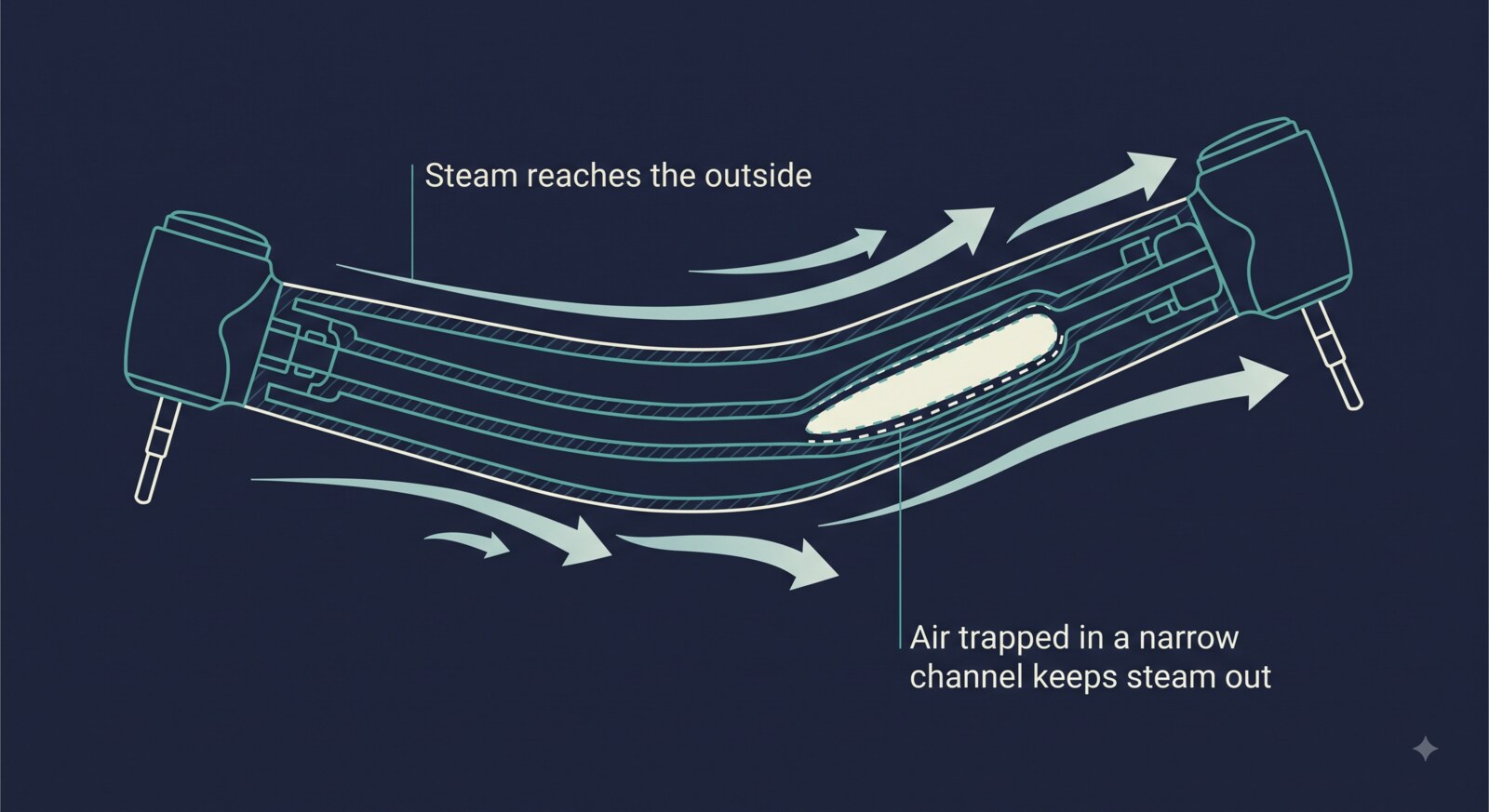
This matters more than it sounds. A handpiece wiped on the outside and put back into use without heat sterilisation is one of the reprocessing failures investigators found in the reported transmissions described further down.
What does the strip on the pouch tell you?
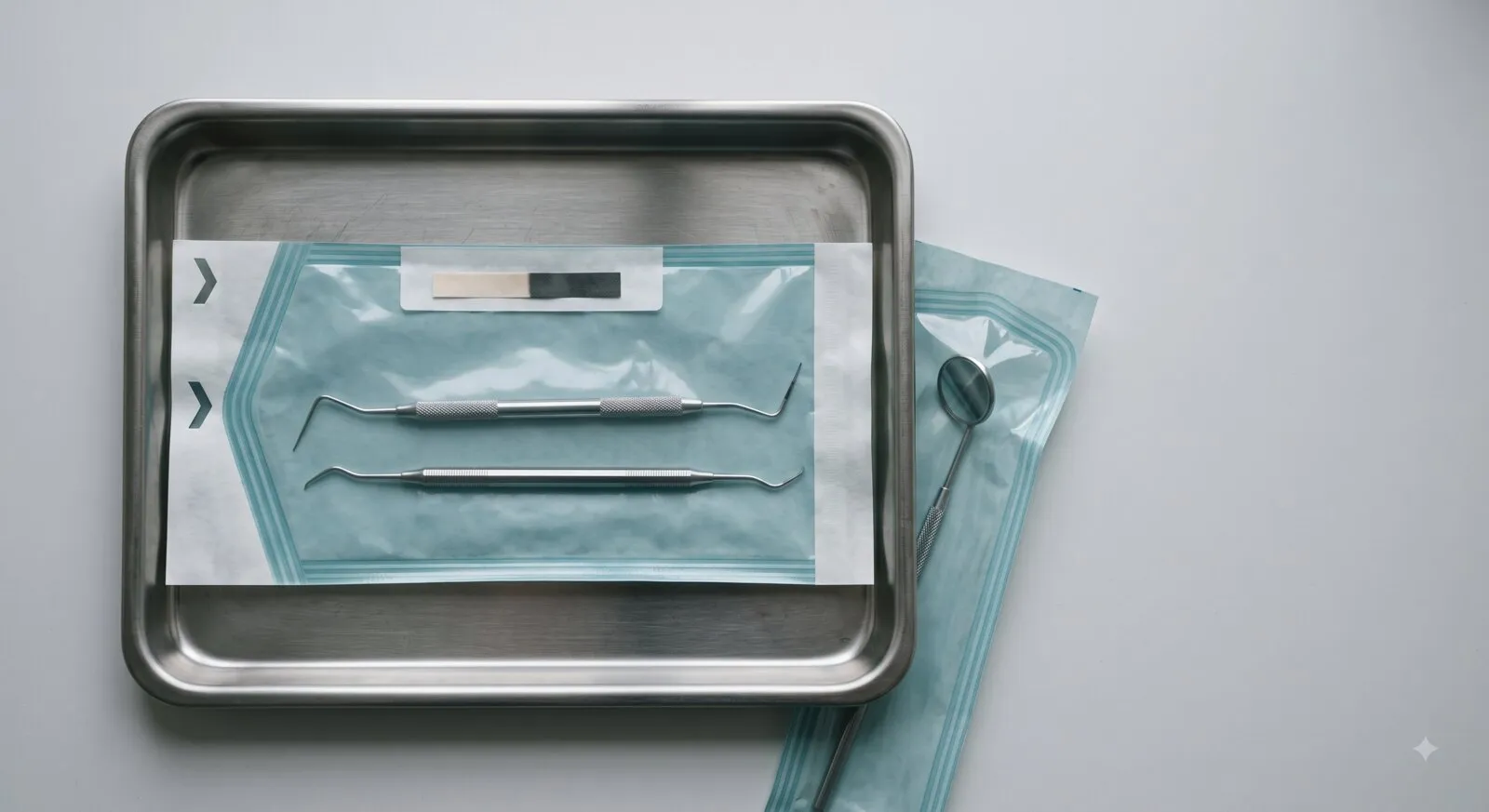
That the pack went through a cycle in which certain conditions were reached — which is worth knowing, and is not the same as a test of whether the load was sterilised. The 2024 review describes chemical indicators as showing "that certain temperatures, times, and steam exposure conditions have been reached", and lists misreading them among the ordinary operator errors, alongside choosing the wrong cycle, wrapping badly and overloading the chamber.
Three different checks exist, and they answer three different questions:
- Physical or mechanical — the machine's own gauges, printout or data log, showing what the cycle did. Read per cycle.
- Chemical — the strip or tape on the pack, showing that pack met the conditions. Read per pack.
- Biological, also called a spore test — deliberately putting resistant bacterial spores through a cycle and then culturing them, which is the only one of the three that tests killing power directly.
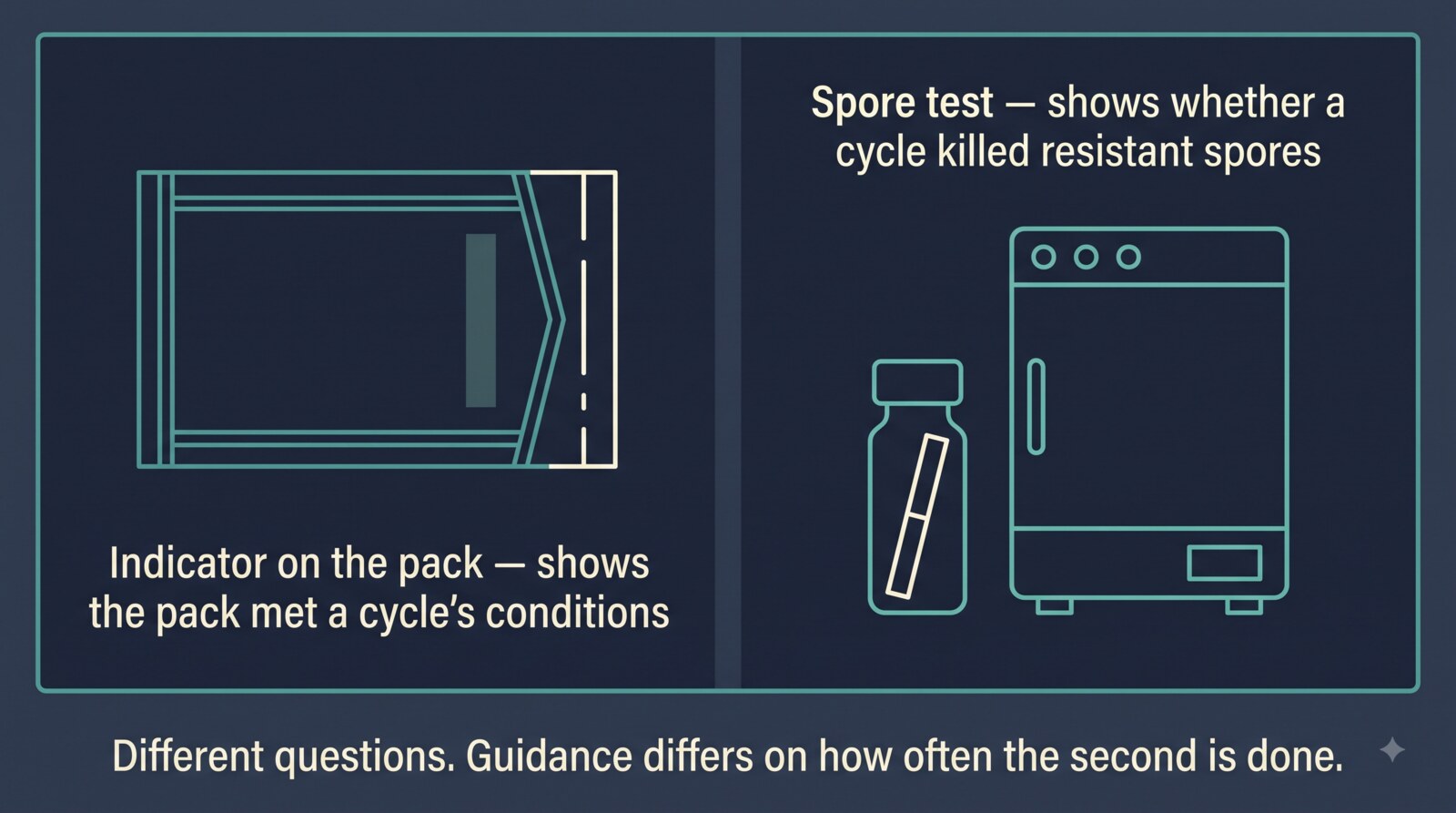
Authorities do not agree on how often the third one is needed, and it would be misleading to pretend otherwise. WHO's manual asks for biological indicators "at least daily", chemical indicators on each package and physical indicators on each cycle. England's national dental standard, HTM 01-05, requires a different set — a daily steam-penetration test on vacuum sterilisers, an automatic control test on every benchtop steriliser, a recorded temperature and pressure, and weekly air-leakage or residual-air tests — and does not require biological indicators at all. A practice can therefore follow one recognised standard closely and still not run spore tests, which is why "do you spore test?" is a poor question to judge a clinic by.
How often does sterilisation actually go wrong?
The best recent measurement comes from Mexico, and it counts tests rather than clinics. Researchers in San Luis Potosí invited 207 dental practices and enrolled 175 of them, then put biological indicators through 210 sterilising machines six times over a year: of 1,188 indicator tests, 128 — 11% of the tests — grew bacteria afterwards. Dry-heat units grew bacteria in 13% of their tests against 10% for steam autoclaves, a difference the study did not find statistically significant overall — it reached significance only at the first of the six checks. The factor that was associated with failure was error in the machine's temperature and time settings, at roughly four times the odds.
Two details change how that number should be read, and both are in the paper. Failures concentrated rather than spreading evenly: 18 machines were withdrawn from the study after failing three checks in a row. And the study's own authors note that routine spore testing is not widespread in Mexico even though health authorities there recommend it — so this is a picture of machines that were mostly not being tested until somebody tested them. The encouraging half is that repeated checking drove the failure rate down over the year. None of it can be converted into a proportion of clinics anywhere, and it says nothing measured about Pakistan.
Can you catch hepatitis from dental treatment?
Transmission has been documented, it is rare in the published record, and that record under-counts — all three of those are true at once. A 2016 review in the Journal of the American Dental Association searched the literature from January 2003 to November 2015 alongside national surveillance and found three reported transmission events in US dental settings: hepatitis B in an oral surgery practice in 2002 (one patient), a 2009 hepatitis B outbreak at a portable dental clinic that infected five people including two staff, and hepatitis C in an oral surgery practice in 2013 (one patient). The authors call transmission in US dental settings "infrequent" while noting in the same paper that events go unlinked because hepatitis B and C can incubate for months and health departments have limited capacity to trace them — so "rare in the record" is not the same as "rare".
What the investigators found across those three events is as informative as the count: the failures they identified were in the process rather than in the absence of equipment — handpieces wiped instead of heat-sterilised, instruments processed unwrapped, untrained and unvaccinated helpers, and unsafe handling of injected medication.
For Pakistan the picture has to be assembled honestly, because it is easy to draw a straight line here that the data do not support. WHO's Global hepatitis report 2026 records Pakistan as the country with the largest number of people living with hepatitis C — about 9 million in 2024 — and attributes the regional burden largely to historical health-care-associated transmission, "particularly the widespread reuse of needles for injections". The same report names dental treatment explicitly as one of the health-care exposures that are common in a person's life, writing of "other unsafe health care exposures, such as dental treatment or injections". So dentistry is on WHO's list of exposures worth getting right.
Where Pakistani data can compare exposures directly, the sharpest result points at injections. Two household surveys in Sindh — 8,855 people in 2007 and 6,672 in 2019, with exposures self-reported as an ever-history — found that adults who reported having had an invasive dental procedure were no more likely to test positive for hepatitis C once other exposures were accounted for (adjusted odds ratio 0.9, 95% CI 0.7 to 1.2), while adults who had had a therapeutic injection in the past year were about twice as likely to test positive (adjusted odds ratio 2.1) — and injections accounted for an estimated 38.1% of hepatitis C exposure in that population, meaning about two in five of the infections there could be traced back to that one exposure. A survey of this kind can neither prove nor rule out transmission in any individual clinic; it describes a province, from what people remembered about their own histories.
Internationally the question is genuinely unsettled. A 2019 review in the Journal of Clinical and Translational Hepatology gathered 26 studies of dental care as a hepatitis C risk factor and found roughly half reporting an association and half none, concluding that "in developed nations, general dental care does not appear to be a significant risk factor for HCV transmission" while, in the developing world, "the improper use of sterile technique and lack of provider education likely increase the risk". All of those studies are observational, which means they can show patterns and cannot establish cause.
Read together: the evidence does not support telling you that dental instruments are driving hepatitis in this country, and it does not support telling you the risk is zero either. It supports caring about the process. If what you actually want to know is whether any of this should change your own decision to be seen, that is answered below, under "Should any of this stop you booking treatment?".
What can you see at the chair?
Four things, and each of them shows one step rather than the whole chain. This is what it looks like when the sequence has been followed:
- Instruments come out of a sealed pouch, opened in front of you. That shows the pack was still closed when it reached you — WHO's manual asks for critical items to be used immediately after sterilisation or kept in bags until use, and re-sterilised if a bag is damaged.
- The pouch carries an indicator and a date. The indicator shows that pack met the conditions of a cycle; the date exists because packs do not stay usable forever. HTM 01-05 gives an example of how far that can stretch: wrapped instruments may be stored up to a year, while unwrapped instruments kept in the clinical area get a single day.
- Single-use items are opened fresh. The needle, the syringe, the suction tip, the rinsing cup — new packaging, opened at the chair, thrown away afterwards.
- The handpiece changes between patients. Harder for a patient to be sure about than the others, since a swapped drill and a wiped one look similar from the chair — which is exactly why it belongs on the list of things worth asking about rather than watching for.
What happens out of sight?
Everything on that list belongs to the last of the six steps; the other five, set out in the sections above, happen before you sit down. That is the honest asymmetry in this subject: what stands in for those five is not vigilance on your part, it is whether the practice keeps records of them, and whether it can tell you about them without discomfort.
What is fair to ask, and what does a good answer sound like?
Ask what checks are run on the steriliser and what gets recorded. It is a fair question for any clinic, including ours, and it has a real answer rather than a yes or no.
A good answer is specific and unbothered: it describes the cycle records the machine produces, the indicator on each pack, whether the practice also runs periodic spore tests — remembering that recognised standards differ on whether those are required — and what happens to a load if a check fails. An answer that sounds rehearsed is fine; the point is that somebody in the building knows the process well enough to describe it. If you would rather ask before you travel, a message works as well as a conversation in the chair.
Should any of this stop you booking treatment?
No, and we would say the same if you were booking with someone else. The documented transmissions in dentistry are rare events in a record that also under-counts them, while the harms of not being seen are ordinary and predictable: decay reaches the nerve, gum disease loosens teeth that could have been kept, an abscess turns into a swelling that needs a hospital rather than a dentist.
Anxiety about hygiene is one of the reasons people put off dental care for years. Knowing how the process works is meant to make the chair easier to sit in, not harder.
What we do not know
- How many transmissions go unrecognised. For the reasons the hepatitis section gives, counts of documented cases are a floor rather than a measure of risk, and nobody can say how far below the real number they sit.
- How often spore testing should happen. The section on pouch indicators sets out where the two standards differ; which of them is right is not something we can settle, and no figure we could give you would be more than one body's answer.
- What Pakistani clinics do today. We could not find current Pakistan-specific data on how dental practices monitor sterilisation. The measurements we found are older, self-reported, or from other countries, and we have not treated any of them as a national picture.
Why are we telling you this?
Because the usual version of this subject comes in two unhelpful shapes: a marketing line saying instruments are sterilised, which no patient can check, or an alarm about dirty instruments, which sends anxious people away from care they need. We sell no oral-care products and this article links to none. Where the evidence is unsettled — the spore-testing question, and what happens in clinics here — we have said so rather than rounding it into a claim.
Evidence last checked: August 2026.
If you have been putting off treatment, book a consultation at Happy Tooth Dental Clinic in Johar Town, Lahore and ask us anything on this page; Dr. Manahil Iftikhar answers the sterilisation question in the same detail as any clinical one.
Related reading: professional cleaning and prevention, the credentials worth verifying before you book, how dental work is divided between specialists in Pakistan, and how the clinic came to be.
Sources
- World Health Organization, Pan American Health Organization. Decontamination and reprocessing of medical devices for health-care facilities. Geneva: WHO; 2016. ISBN 978 92 4 154985 1 — international guidance; the dental chapter, the sterilisation checklist and the monitoring tables are the sections used here.
- Department of Health. Health Technical Memorandum 01-05: decontamination in primary care dental practices. NHS England; 2013 edition — national standard for England; daily and weekly steriliser tests, instrument wrapping and storage times.
- Walsh LJ. Current challenges in environmental decontamination and instrument reprocessing. International Dental Journal. 2024;74(Suppl 2):S455-S462 — narrative review; cleaning before sterilisation, chemical indicators and operator error.
- Patiño-Marín N, Villa-García LD, Terán-Figueroa Y, et al. Presence and causes of sterilization equipment failures with biological indicators in dental offices in Mexico: a longitudinal cohort. Medicina (Kaunas). 2024;60(9):1525 — 175 dental offices, 210 sterilising units, 1,188 biological-indicator tests over one year in San Luis Potosí, Mexico.
- Cleveland JL, Gray SK, Harte JA, Robison VA, Moorman AC, Gooch BF. Transmission of blood-borne pathogens in US dental health care settings: 2016 update. Journal of the American Dental Association. 2016;147(9):729-738 — review of reports from January 2003 to November 2015 plus national surveillance; three reported transmission events, and the authors' own note on under-recognition.
- World Health Organization. Global hepatitis report 2026. Geneva: WHO; 2026 — Pakistan's hepatitis C burden, the regional attribution to health care-associated transmission, and health care exposures including dental treatment.
- Alamneh TS, Walker JG, Lim AG, et al. Changes in the prevalence of hepatitis B and C viral infections in Sindh province, Pakistan: findings from two sero-surveys in 2007 and 2019. Journal of Viral Hepatitis. 2024;31(11):645-656 — household sero-surveys of 8,855 and 6,672 people; adjusted odds ratios for self-reported exposures, and the attributable fraction for therapeutic injections.
- Averbukh LD, Wu GY. Highlights for dental care as a hepatitis C risk factor: a review of literature. Journal of Clinical and Translational Hepatology. 2019;7(4):346-351 — 26 observational studies, split roughly evenly on whether dental care was associated with infection.
- Siddiqui HK, Ikram K, Aftab NH, Uzair F. Knowledge and practice of sterilization among different health care workers. Pakistan Oral & Dental Journal. 2014;34(3):507-509 — 500 self-reported questionnaires from dental colleges in Karachi, data collected in 2012.