In short: dental care during pregnancy is safe and important. Hormonal changes make gums inflame and bleed more readily, and morning sickness exposes enamel to stomach acid. Routine check-ups and cleaning should continue, urgent treatment should not be delayed, and non-urgent X-rays usually wait — though a genuinely necessary one with shielding is considered safe. Tell your dentist you are pregnant.
Pregnancy brings about numerous changes in a woman's body, including surprising effects on oral health. Hormonal fluctuations, changing dietary habits, and morning sickness can all impact your teeth and gums.
How Pregnancy Affects Oral Health
Pregnancy Gingivitis
Pregnancy gingivitis — red, swollen gums that bleed easily — is very common, driven by hormonal changes rather than by any lapse in your brushing. It usually appears in the second trimester and settles after delivery, but it should still be treated rather than waited out.
Increased Risk of Tooth Decay
Morning sickness introduces stomach acid into the mouth, eroding tooth enamel. Pregnancy cravings for sugary foods can also increase cavity risk.
Is Dental Treatment Safe During Pregnancy?
First Trimester
- Inform your dentist about your pregnancy
- Schedule a comprehensive dental exam
- Focus on treating immediate issues like pain or infection
Second Trimester
- Ideal time for necessary dental treatments
- Routine cleanings and necessary procedures are generally safe
- Postpone elective cosmetic procedures until after delivery
Third Trimester
- Continue routine dental cleanings
- Avoid lengthy procedures after week 36
- Address any acute issues promptly
X-rays, Anaesthetic and Medicines
These are the three questions expectant mothers actually ask, and the answers are more reassuring than the rumours.
- X-rays. Routine ones can usually wait, but a genuinely necessary dental X-ray is not a reason to leave an infection untreated. The American College of Obstetricians and Gynecologists states that dental X-rays with shielding of the abdomen and thyroid are safe during pregnancy — a dental film is a small, tightly focused exposure well away from the uterus, and digital sensors reduce it further still.
- Local anaesthetic. Lidocaine, with or without adrenaline, is considered safe in pregnancy. Refusing anaesthetic and enduring the procedure is not the safer choice; pain and stress are not neutral for either of you.
- Painkillers and antibiotics. Paracetamol is the usual first choice. Ibuprofen and other anti-inflammatory painkillers are generally avoided, particularly in the third trimester. Some antibiotics are used routinely in pregnancy and others are not — which is exactly why your dentist needs to know that you are pregnant, and how far along, before writing anything.
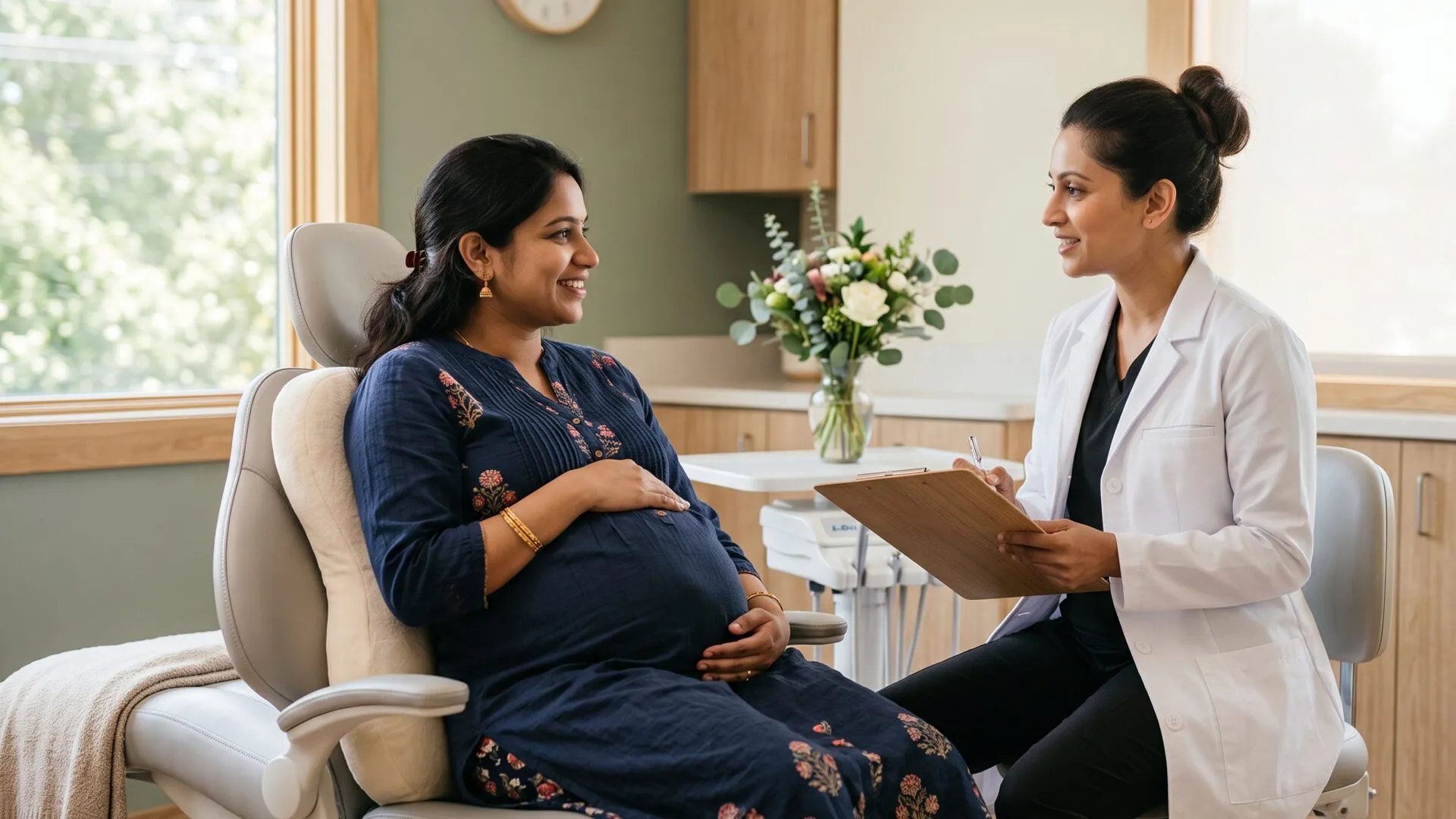
Tell your dentist at the first appointment, and pass on any specific instruction your obstetrician has given you.
Comfort and Positioning Later On
From around the middle of the second trimester, lying flat on your back can press the weight of the uterus onto a major vein and leave you dizzy, breathless or nauseated. It is easily prevented: ask to be tilted onto your left side with a cushion under the right hip, and speak up the moment you feel unwell rather than waiting for the procedure to finish. Shorter appointments and a chance to sit up and move between stages are reasonable requests, not fussiness.
How Do You Manage Pregnancy Dental Problems?
Morning Sickness
- Rinse with water mixed with baking soda to neutralize acid
- Wait 30 minutes before brushing after vomiting
- Use a soft-bristled toothbrush
Sensitive Gums
- Brush gently but thoroughly twice daily
- Floss daily, being careful around tender areas
- Maintain regular dental cleanings
A Lump on the Gum
A soft red swelling between two teeth that bleeds easily and appears around the second trimester is common enough to have its own name: a pregnancy epulis, or pyogenic granuloma. It is benign, it is not a tumour in the sense the word suggests, and it usually shrinks or disappears after delivery. Show it to a dentist anyway — partly to confirm what it is, and partly because thorough cleaning often settles it. Removal during pregnancy is normally reserved for lumps that bleed heavily or get in the way of eating.
How Common Is This, and Does It Actually Matter?
Gum inflammation in pregnancy is not a rare complication. A systematic review and meta-analysis pooling studies from many countries put the prevalence of periodontal disease in pregnancy at roughly two in five women — high enough that a pregnant patient with sore, bleeding gums should be treated as ordinary rather than alarming.
Whether treating it changes the outcome of the pregnancy is a separate and more careful question, and it is worth being honest about where the evidence sits. Meta-analyses consistently find an association between periodontal disease and preterm birth. What they have not shown is that treating gum disease during pregnancy reliably prevents preterm birth — the trials that tested exactly that have been mixed. One large review also found the strength of the association varies with the income level of the population studied, which is the signature of a relationship in which poverty, nutrition and access to care are doing part of the work.
So the honest version is this: treat the gum inflammation because inflamed, bleeding gums are worth treating on their own terms, because scaling and better home care are safe in pregnancy, and because the association exists. Do not treat it because someone promised it would prevent a premature birth. Nobody can promise that.
What Do the Numbers Say About X-rays in Pregnancy?
A systematic review of dental imaging in pregnancy concluded that diagnostic dental radiography delivers a fetal dose far below the thresholds at which radiation risk to a fetus is considered to begin, and that the imaging should not be withheld when it is genuinely needed for diagnosis. A review published in the journal of the American Dental Association reached the same conclusion after tracing the history of the advice, and noted that much of the caution patients have absorbed is inherited from an era of much higher doses and slower film.
The practical rule we follow is unchanged: routine screening films wait, a film needed to diagnose pain or infection does not, and the abdomen and thyroid are shielded either way.
What Makes Getting Dental Care Harder in Lahore While Pregnant?
Two practical obstacles come up far more often here than any clinical one. The first is being turned away. Some clinics in Lahore will decline to treat a pregnant patient at all, or will defer everything to "after delivery" as a blanket policy. That is not a clinical judgement, and an untreated abscess does not become safer by waiting six months. If you are refused treatment for a painful tooth on the grounds of pregnancy alone, ask what specifically is unsafe about the treatment being proposed.
The second is the gap after delivery. In practice the appointment that gets missed is not the one during pregnancy — it is the one in the year afterwards, when a newborn absorbs everything. Book the postnatal check before you leave the clinic, while the date is still easy to choose.
At our clinic in Johar Town we ask for your due date at the time of booking, so a longer appointment can be scheduled early in the second trimester rather than squeezed into the third, and so the chair can be set up for you before you arrive rather than adjusted once you are already uncomfortable.
Can Anything Now Protect the Baby's Teeth Later?
A Cochrane review of interventions aimed at pregnant women, new mothers and other primary caregivers found that counselling and preventive care directed at the caregiver can reduce early childhood decay in the child — with the evidence strongest where the support continued after the birth rather than stopping at delivery. The practical version is unremarkable and worth doing anyway: treat the mother's own untreated decay before the baby arrives, do not share spoons or clean a soother in your own mouth, and never put a bottle of anything sweet in the cot.
Does a Baby Really Cost You a Tooth?
No. "Har bachay pe aik daant" is one of the most durable beliefs in South Asian households, and the mechanism it assumes — the baby pulling calcium out of the mother's teeth — is not how teeth work. The calcium in enamel is locked into a crystalline structure and is not mobilised the way calcium in bone is. A developing baby draws on the mother's skeleton and diet, not on her teeth.
What is true is that pregnancy really does cost some women teeth, for reasons that are entirely preventable: hormone-driven gum inflammation left untreated, enamel eroded by repeated morning sickness, more frequent snacking, and dental visits postponed for nine months and then through a year of a newborn. Every one of those is manageable. The tooth is lost to the delay, not to the pregnancy.
With sensible care you can go through pregnancy and come out of it with your teeth and gums in the same condition you started — better, often, since this is the period when most women pay closest attention to their health. Gum inflammation now is also worth taking seriously for its own sake: the link between untreated gum disease and preterm birth is one of the better-studied connections between the mouth and the rest of the body. Schedule a prenatal dental check-up, and mention your due date when you book.
Sources
- Chen P, Hong F, Yu X. Prevalence of periodontal disease in pregnancy: A systematic review and meta-analysis. Journal of Dentistry. 2022;125:104253.
- Montoya-Carralero JM, Ávila-Villasmil R, Sánchez-Pérez A, Jornet-García A, Terrer-Alonso E, Moya-Villaescusa MJ. Relationship between periodontal disease and preterm birth. A systematic review and meta-analysis. Medicina Oral Patología Oral y Cirugia Bucal. 2024;29(6):e857–e865 — an association; the treatment trials are a separate and less settled question.
- Moliner-Sánchez CA, Iranzo-Cortés JE, Almerich-Silla JM, Bellot-Arcís C, Ortolá-Siscar JC, Montiel-Company JM. Effect of per Capita Income on the Relationship between Periodontal Disease during Pregnancy and the Risk of Preterm Birth and Low Birth Weight Newborn. Systematic Review and Meta-Analysis. International Journal of Environmental Research and Public Health. 2020;17(21):8015.
- Gamba TO, Visioli F, Bringmann DR, Rados PV, da Silveira HLD, Flores IL. Impact of dental imaging on pregnant women and recommendations for fetal radiation safety: A systematic review. Imaging Science in Dentistry. 2024;54(1):1–11.
- Flagler CK, Troici CM, Rathore SA. A historical review of the effects of dental radiography on pregnant patients. Journal of the American Dental Association. 2022;153(10):989–995.
- Gomersall JC, Slack-Smith L, Kilpatrick N, Muthu MS, Riggs E. Interventions with pregnant women, new mothers and other primary caregivers for preventing early childhood caries. Cochrane Database of Systematic Reviews. 2024;5(5):CD012155.