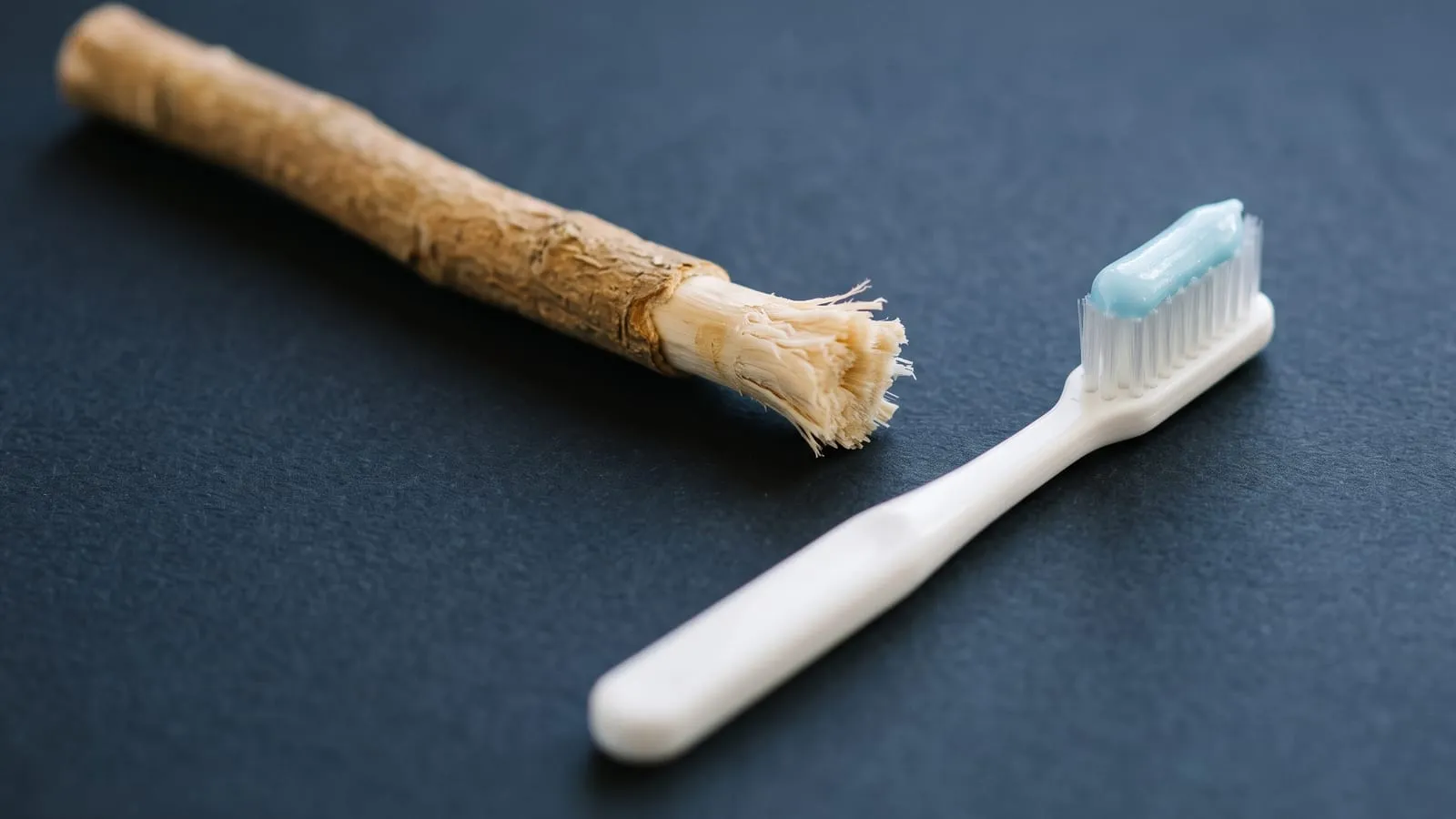
Short answer: miswak and toothpaste do different jobs, so the comparison people usually make is not the one the evidence answers. Miswak is a cleaning tool like a toothbrush, and trials have not shown it to clean better or worse — but those trials are small and short, and the reviewers who pooled them call for caution. Toothpaste is how fluoride reaches your teeth, and a miswak releases almost none. Adding miswak to ordinary brushing may help slightly more than brushing alone; nothing in the research shows that either tool can be dropped.
Miswak — the chewing stick cut from Salvadora persica, sold here as peelu — has cleaned teeth in this region for centuries, and for many families it carries religious and cultural meaning alongside its practical use. This article does not weigh that meaning. It asks a narrower question: when researchers measure plaque, gum inflammation and cavities, what actually happens?
How did we weigh the evidence?
Four kinds of evidence appear below, and they are not equal. Health writing on this topic mixes them and presents them at the same volume; we say which is which every time a claim is made:
- Randomised trials in patients — the strongest evidence available here, and still limited: most are small, run for two to three weeks, and cannot blind a participant to whether they are holding a stick or a brush.
- Laboratory studies — show what a plant compound does to bacteria in a dish. They explain a possible mechanism. They do not show that anything happens in a mouth.
- Surrogate measures — bacterial counts in saliva, for instance. Useful signals, but not the same as counting cavities.
- Traditional use — evidence that a practice is long-standing and valued, not evidence of a clinical outcome.
Where the reviewers who pooled these trials describe their own evidence as limited, or end by calling for more of it, we say so rather than rounding it up.
Is miswak better than toothpaste?
They are not alternatives: a miswak competes with your toothbrush, not with your toothpaste. A brush and a chewing stick do the same job — physically disturbing the sticky bacterial film that forms on teeth every day. Toothpaste is not a cleaning tool at all. It is a carrier.
That is measurable rather than rhetorical. A systematic review in the Journal of Clinical Periodontology pooled trials of brushing with and without toothpaste and found 49.2% of plaque removed with it and 50.3% without — concluding with moderate certainty that toothpaste adds nothing to the mechanical removal of plaque.
So toothpaste's contribution is chemical rather than mechanical. It is how fluoride reaches your teeth, and in some formulations how ingredients for sensitivity or gum inflammation get there too. Two comparisons therefore hide inside the popular one: miswak against a toothbrush, which is a fair contest between two tools, and miswak against fluoride, which is not a contest at all.
Is miswak as good as a toothbrush?
No trial has shown miswak to remove more or less plaque than a toothbrush — but "no difference detected" is not the same as "proven equivalent", and this evidence is weak. The trials are small, short, unblinded and inconsistent with one another, and the reviewers who pooled them close by saying that more evidence is required.
The largest meta-analysis, published in the Journal of Ethnopharmacology in 2022, identified ten randomised trials and pooled nine of them. Miswak used on its own was statistically indistinguishable from a toothbrush for plaque (SMD 0.39; 95% CI -0.05 to 0.83) and for gum inflammation (SMD 0.13; 95% CI -0.16 to 0.43). Worth knowing: that review pooled trials of Salvadora persica sticks together with neem (Azadirachta indica) sticks, so it is not purely a peelu-miswak result.
An earlier meta-analysis agreed on plaque and suggested miswak might do better on gums — but the studies it combined disagreed with each other so strongly that the finding should be treated as unsettled rather than established. The most recent review, published in Oral Health and Preventive Dentistry in February 2026 and covering 31 studies across 14 countries, reaches the same balanced place: traditional practices "may offer benefits similar to conventional methods", with methodological limitations that "necessitate cautious interpretation".
Two trials show how much the result depends on the person holding the stick. In a Malaysian trial of 78 adults who were taught a technique first, chewing sticks matched a standard toothbrush used with fluoride toothpaste over three weeks, and did slightly better on gum inflammation around the front teeth. In a Saudi trial of 60 women who were not regular miswak users, the opposite happened over two weeks: plaque did not fall in the miswak group at all (p = 0.58) while it fell in the toothbrush group (p = 0.007), and the miswak group's gum scores got significantly worse (p < 0.001). The authors suggest over-vigorous use as the explanation; the two groups also started from different plaque levels, so the trial is not a clean read either way.
Setting two separate trials side by side is not the same as testing the question directly, so the most reasonable reading is that how the stick is used may matter as much as which tool it is — an inference from two small trials, not an established finding.
Can miswak replace fluoride toothpaste?
No — and the reason is not how much fluoride the plant contains, but how little of it comes out. A review in the Saudi Dental Journal reports two separate measurements. The stick itself holds roughly 1 microgram of fluoride per gram of material. When miswak is soaked in water, what actually dissolves out is a negligible 0.07 micrograms per millilitre. Those are different quantities measured in different ways, and it is the second one that matters in a mouth — which is why the review concludes that miswak's contribution to preventing decay is doubtful.
The clearest sign of that gap is what researchers had to do about it: to get a meaningful amount of fluoride from a chewing stick, they soaked the sticks in sodium fluoride first. The plain stick does not deliver it.
Toothpaste is a different proposition — 1,000 to 1,500 parts per million of fluoride, applied directly to the tooth, twice a day. Cochrane's review of 96 studies found high-certainty evidence that toothpaste at 1,000 to 1,250 ppm prevents decay in children and adolescents compared with fluoride-free toothpaste, and moderate-certainty evidence that 1,450 to 1,500 ppm does slightly better; the evidence for concentrations below 1,000 ppm is uncertain rather than settled. Adults benefit too — a separate meta-analysis found that fluoride averted about 0.29 decayed coronal tooth surfaces per person per year in studies published from 1980 onwards. That body of evidence is why the World Health Organization added fluoride toothpaste to its Model List of Essential Medicines in 2021.
So "miswak contains fluoride" is true, and "miswak gives you fluoride protection" is not.
Does miswak prevent cavities?
Nobody has shown that it does, and the one trial that measured cavities could not tell the approaches apart. That trial followed 26 high-risk adults per group for a year and found no new cavities in any group — including the control. A trial in which nothing happens in any arm cannot demonstrate that two approaches are equivalent, though it is regularly cited as if it had.
What does exist is indirect. In a three-month trial of high-caries-risk schoolboys, plaque fell in both the miswak and the fluoride-toothpaste groups, and the proportion of decay-associated bacteria in the miswak group's saliva shifted slightly in a favourable direction. That is a surrogate measure — bacteria counted in saliva, not cavities counted in teeth. In the laboratory, benzyl isothiocyanate, a compound concentrated in Salvadora persica roots, kills gum-disease bacteria quickly in test conditions. That is a plausible mechanism, in a dish.
The distinction is worth carrying into any health claim you read: killing bacteria in a laboratory is a mechanism, and preventing disease in patients is a result. Fluoride has the result. Miswak, so far, has the mechanism.
Is it worth using a miswak as well as a toothbrush?
Possibly — this is where the limited evidence is least discouraging. In that 2022 meta-analysis, the only comparison that reached statistical significance was miswak used in addition to toothbrushing, measured against toothbrushing alone: slightly better plaque scores (SMD 0.68; 95% CI 0.14 to 1.22) and gum scores (SMD 0.66; 95% CI 0.03 to 1.29).
Three qualifications belong with those numbers: the confidence intervals are wide, the gum result only just clears the threshold, and the same species caveat applies — Salvadora persica and neem sticks were pooled. The trials underneath the figure are also small and short, which is why the review that produced it ends by saying more evidence is required.
Note also what was never tested. Miswak-plus-brushing was compared with brushing alone; it was not compared with miswak alone. So the fair reading is narrow: adding a miswak to normal brushing may give a small extra benefit, and none of this evidence shows that either the brush or the toothpaste can be dropped.
Is miswak safe for your gums?
Generally yes when it is used gently, but "completely harmless" is not what the research shows. A 2025 systematic review in the Journal of Herbal Medicine gathered nine studies covering 6,315 people and found that most, though not all, reported more gum recession among miswak users than among toothbrush users; one 2024 study found no difference at all. The reviewers pooled no overall figure, and were explicit that this does not establish that miswak causes recession — the studies were mostly snapshots in time, measured recession in different ways, and could not account for how hard, how often, or with what kind of stick people were brushing.
Alongside that sit case reports of unusual wear notches at the gumline and gum injuries in heavy users, and an older review noting an association between excessive miswak use and recession in Saudi schoolchildren.
The likely explanation is not that miswak is dangerous. It is that any firm object used with force, several times a day, for years, wears gums and the softer root surface beneath them. A toothbrush scrubbed hard does the same thing.
What does miswak not do?
- It does not clean between your teeth — and neither does a toothbrush. Two of every tooth's five surfaces face its neighbours, which is where a lot of adult decay and gum disease starts. Floss or interdental brushes are the answer whichever tool you use.
- It reaches some surfaces poorly. A miswak's fibres run along the length of the stick rather than across it, and reviews and trialists both note that this makes tongue-side surfaces and the teeth at the back harder to clean properly.
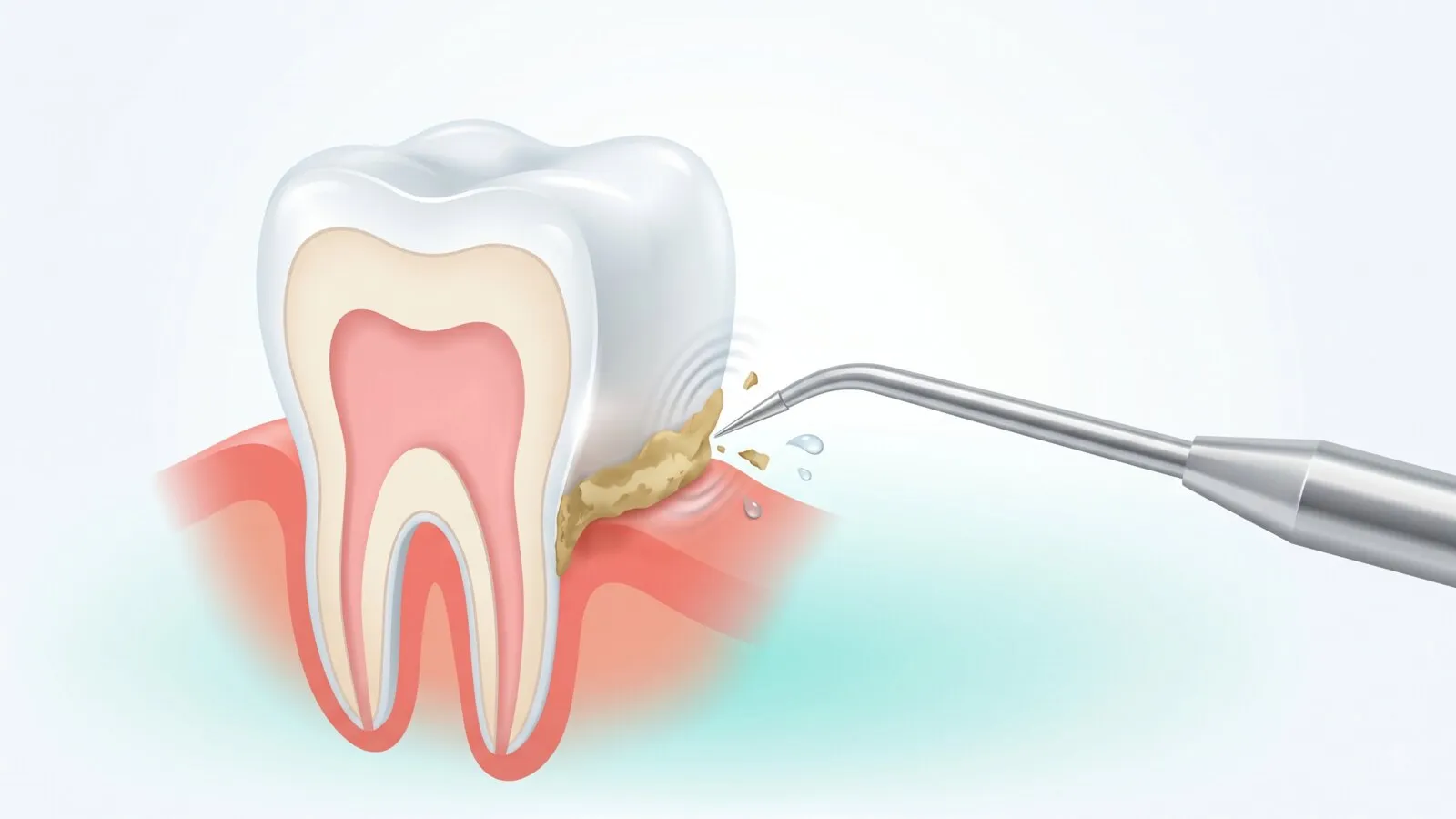
- It does not remove tartar. Once plaque hardens, nothing you use at home removes it — that needs scaling and preventive care in the clinic, and what that cleaning does to the tooth underneath has been studied more closely than most people expect.
- It does not replace an examination. Early decay and early gum disease are painless, and are found by looking, not by feel.
Does miswak whiten teeth or freshen breath?
Breath: plausibly, and briefly. Whitening: not demonstrated in patients. Chewing a miswak stimulates saliva, which helps buffer acid and wash bacteria away, and users consistently describe a fresher mouth. A trial comparing miswak with a chlorhexidine mouthwash for bad breath was registered, but we could not find published results for it, so treat the breath claim as reasonable rather than proven.
The whitening claim is weaker than it looks. It traces to a laboratory study in which extracted premolars were stained with tea and coffee, then brushed by machine with a concentrated Salvadora persica paste; the stained surfaces lightened by at least one tone on the standard dental shade guide. That was a paste, applied by a machine, to teeth outside a mouth. Any stick or brush lifts surface stain from tea, chai or paan — and that is stain removal, not a change in the colour of the tooth itself.
How should a miswak be used?
Gently, with light pressure — but the honest starting point is that no standardised miswak technique has ever been established in the research. Two reviews say so directly, and note that most users learn by imitation rather than instruction. Technique is where the harm and the benefit both come from, so what follows is labelled by how well supported it is.
- Indirect evidence: being taught a technique appears to matter. In the trial that taught participants a technique first, chewing sticks matched a standard toothbrush; in the trial whose participants were not regular users, they did not. That is a comparison between two separate trials, not a test of training itself.
- Evidence-informed: use light pressure and short strokes, and avoid hard horizontal scrubbing. This is the direction the harm reports point — case reports of gumline wear follow forceful scrubbing, and the trial where gum scores worsened was explained by its authors as over-vigorous use.
- Standard clinical advice: stop and have it looked at if your gums bleed for more than a few days after starting, or if the gumline becomes sensitive. Do not share a stick with anyone, for the same reason you would not share a toothbrush.
- Clinical convention, commonly recommended but not tested: peel back a short length of bark at one end, chew that end until the fibres separate into soft bristles, keep it moist rather than using it dry and stiff, trim the tip back and re-chew a fresh one when the fibres flatten or discolour, and store it dry between uses. These are sensible and widely taught. No trial has compared them with any alternative.
How do miswak, toothbrush and toothpaste compare?
| Miswak alone | Toothbrush + fluoride toothpaste | Both | |
|---|---|---|---|
| Plaque removal | No difference detected vs a brush | No difference detected vs miswak | May be slightly better than brushing alone |
| Gum inflammation | No difference detected; worse in one trial of untrained users | No difference detected vs miswak | May be slightly better than brushing alone |
| Cavity protection | Not demonstrated in any trial | Strong, consistent evidence | Comes from the toothpaste |
| Fluoride delivered | Trace, and almost none released in use | 1,000-1,500 ppm | 1,000-1,500 ppm |
| Cleans between teeth | No | No | No - floss or interdental brushes either way |
| Removes tartar | No | No | No |
| Technique sensitivity | Appears high; no standard technique exists | Moderate | Moderate |
| Main risk if misused | Gum recession and gumline wear reported with forceful use | The same with hard scrubbing | The same, if either is forced |
| Practicality | Needs no sink, water or paste | Needs both | - |
| Strength of evidence | Limited - small, short trials | Strong for fluoride | Limited - one meta-analysis |
What should you actually do tomorrow morning?
For most adults, the routine the evidence supports looks like this:
- Brush twice a day for two minutes with a fluoride toothpaste at 1,000-1,500 ppm. Many tubes sold here do not print the figure — if yours does not, check the ingredient panel for sodium fluoride, sodium monofluorophosphate or stannous fluoride, and ask your dentist if it is absent.
- Spit out the excess and do not rinse with water afterwards, which washes away the fluoride you have just applied.
- Clean between your teeth daily with floss or interdental brushes. This is standard hygiene guidance rather than a strong anti-cavity claim.
- Use a miswak as an addition, not a replacement — after lunch, at work, while travelling, whenever brushing is not practical. That is the pattern the adjunctive evidence describes, weak as it is.
- Keep the pressure light whichever tool is in your hand.
- Keep to whatever examination interval your own risk calls for.
If you currently use only miswak, the change worth making is not giving it up — it is adding fluoride toothpaste twice a day. That advice is more relevant here than it might be elsewhere: a 2021 meta-analysis of 30 Pakistani studies put dental-caries prevalence at roughly half the population, though the studies it pooled varied enormously and most were judged at high risk of bias, so treat it as an order of magnitude rather than a precise figure. Habits matter more than the number does — if you sip sweetened tea through the day, how often sugar reaches your teeth matters more than how much of it there is.
It is also worth saying that combining the two is already the normal pattern locally. A 2025 review of miswak use across Africa, the Middle East and Asia found Pakistani studies reporting between 2.5% and 43% of people using miswak alongside a toothbrush, and 11.7% of children using miswak on its own.
Who should ask a dentist before relying on miswak?
- Anyone at high risk of decay — repeated cavities, a dry mouth, or medication that dries the mouth. Ask whether a higher-fluoride toothpaste is appropriate for you; a stick cannot substitute for one.
- Anyone with existing recession, sensitivity or notching at the gumline. Those surfaces do not need additional mechanical wear.
- Anyone in braces or aligners. Fixed appliances create plaque traps a chewing stick cleans poorly — the appliance you are wearing changes what cleaning it needs, so ask your orthodontist what to use.
- Young children. The amount of fluoride toothpaste a child uses is supposed to be measured and supervised, which a stick makes impossible — see how much fluoride toothpaste is right at each age.
- Anyone with bleeding or receding gums right now. That needs diagnosis, not a change of tool; gum inflammation has consequences beyond the mouth.
What don't we know yet?
- Whether miswak affects cavities. No adequately designed trial has answered it.
- What happens over years. Almost every trial runs for two to twelve weeks.
- Whether miswak causes gum recession, or whether heavy-handed use does, or whether the people who use it most differ in other ways.
- What the correct technique is. There is no tested standard to teach, which is an odd gap for a practice this old and this widespread.
What else do patients ask about miswak?
Is miswak toothpaste the same as using a miswak stick?
No. Miswak-branded toothpastes contain Salvadora persica extract in a paste base, used with an ordinary toothbrush, and the extract is one ingredient among many. The question that matters with any such tube is whether it contains fluoride at 1,000 to 1,500 ppm — some herbal pastes do not, and a fluoride-free paste leaves you with the same gap as the stick.
Can I put toothpaste on a miswak stick?
You can, and it does no harm, but it is an awkward way to get fluoride onto teeth: a frayed stick tip holds far less paste than a brush head and spreads it unevenly, so the two minutes of contact fluoride needs are hard to achieve. If the goal is fluoride, use a brush; if it is convenience between meals, use the stick as it is. No evidence suggests combining them on one implement improves either.
Is miswak suitable for children?
Not as their main cleaning. A supervised brush with an age-appropriate fluoride toothpaste is the foundation — a chewing stick makes the amount of toothpaste impossible to control, and younger children find it hard to keep pressure light, which is the factor associated with gum and tooth-surface damage in adults. If an older child wants to use a miswak as well, treat it as an extra between meals and mention it at their next visit.
How long does a miswak stick last, and how should I store it?
There is no tested answer, only common practice: trim the tip back and chew a fresh one once the fibres flatten, discolour or harden, and expect a whole stick to last a few weeks. Rinse it before and after use, and let it dry rather than sealing it damp in plastic. None of this has been compared against any alternative in a trial, so treat it as sensible handling rather than as evidence.
Can I rely on miswak during Ramadan or when I cannot get to a sink?
Miswak suits those moments well — no sink, no water, no paste needed — and using it between meals is exactly the adjunctive pattern the research describes. What it should not displace is the two daily brushings with fluoride toothpaste, which still fit around suhoor and iftar. Whether and when you use a miswak while fasting is a question for your own religious guidance rather than for us.
Why are we telling you this?
Most of what ranks for this question is written by people who sell miswak sticks or toothpaste. We sell neither, and this article links to no product and no shop. Where the evidence is weak we have said so, including where it is weak in a direction that would have made a better headline.
Evidence last checked: August 2026, including the most recent systematic review available at that time. This information is educational and not a substitute for a dental examination — if you are unsure what your teeth and gums need, book a consultation and ask. If you want the wider routine this fits into, see the daily habits and check-ups that prevent most dental problems.
Sources
- Ramli H, Nor Aripin KN, Mohd Said S, Mohamad Hanafiah R, Mohd Dom TN. The effectiveness of miswak (Salvadora persica L. and Azadirachta indica A.Juss.) practices in reducing plaque and gingivitis among adults: a systematic review and meta-analysis. Journal of Ethnopharmacology. 2022;298:115598.
- Adam FA, Mohd N, Rani H, Baharin B, Mohd Yusof MYP. Salvadora persica L. chewing stick and standard toothbrush as anti-plaque and anti-gingivitis tool: a systematic review and meta-analysis. Journal of Ethnopharmacology. 2021;274:113882.
- Shahzad M, Ahmad HA, Ambadi S, Peterson S, Yang I. Traditional oral hygiene practices and their effectiveness: a systematic review of the evidence. Oral Health and Preventive Dentistry, February 2026 — full text.
- Halib N, Nuairy NB, Ramli H, et al. Preliminary assessment of Salvadora persica whitening effects on extracted stained teeth. Journal of Applied Pharmaceutical Science. 2017;7(12):121-125 — laboratory study, extracted teeth and a brushing simulator.
- Azizan NF, Mohd N, Nik Azis NM, Baharin B. Effectiveness of Salvadora persica toothbrush and Salvadora persica chewing stick in plaque and gingivitis control: a randomised control trial. BMC Complementary Medicine and Therapies. 2023.
- Abdellatif HM, Hebbal M, Alsagob E, et al. Comparative effectiveness of miswak and toothbrushing on dental plaque and gingivitis: a randomised controlled trial. Healthcare (Basel). 2024.
- Valkenburg C, Slot DE, Bakker EWP, Van der Weijden FA. Does dentifrice use help to remove plaque? A systematic review. Journal of Clinical Periodontology. 2016;43(12):1050-1058.
- Halawany HS. A review on miswak (Salvadora persica) and its effect on various aspects of oral health. Saudi Dental Journal. 2012;24(2):63-69 — fluoride content and solubility, and reported adverse effects.
- Walsh T, Worthington HV, Glenny AM, Marinho VCC, Jeroncic A. Fluoride toothpastes of different concentrations for preventing dental caries. Cochrane Database of Systematic Reviews. 2019;CD007868.
- Griffin SO, Regnier E, Griffin PM, Huntley V. Effectiveness of fluoride in preventing caries in adults. Journal of Dental Research. 2007;86(5):410-415 — 0.29 coronal surfaces averted per year (95% CI 0.16 to 0.42) in studies from 1980 onwards.
- WHO Model List of Essential Medicines gains a section for dental preparations (2021), including fluoride toothpaste.
- Suleman G, Sidrak M, Noussair Y, et al. The prevalence of gingival recession among miswak (Salvadora persica L.) chewing stick users: a systematic review. Journal of Herbal Medicine. 2025;51:101003.
- Ramli H, Mohd-Dom TN, Mohd-Said S. Clinical benefits and adverse effects of siwak (S. persica) use on periodontal health: a scoping review of literature. BMC Oral Health. 2021.
- Azizan NF, Mohd N, Nik Azis NM, Baharin B. Knowledge, awareness and practice towards the use of Salvadora persica L. (miswak) chewing stick: a scoping review. Healthcare (Basel). 2025 — usage figures and the absence of a standardised technique.
- Sabbagh HJ, AlGhamdi KS, Mujalled HT, Bagher SM. The effect of brushing with Salvadora persica (miswak) sticks on salivary Streptococcus mutans and plaque levels in children: a clinical trial. BMC Complementary Medicine and Therapies. 2020.
- Ibrahim SH, Taha RR, Fawzi EM. Effect of miswak versus standard preventive measures for caries control of young Egyptian adults: a randomised controlled clinical trial. Journal of International Oral Health. 2022;14(3):230-242.
- Sofrata A, Santangelo EM, Azeem M, et al. Benzyl isothiocyanate, a major component from the roots of Salvadora persica, is highly active against Gram-negative bacteria. PLoS ONE. 2011;6(8):e23045 — laboratory study.
- Siddiqui AA, Alshammary F, Mulla M, et al. Prevalence of dental caries in Pakistan: a systematic review and meta-analysis. BMC Oral Health. 2021 — pooled estimate with very high heterogeneity and high risk of bias in most included studies.
- NHS — how to keep your teeth clean: brushing duration and frequency, spitting rather than rinsing, interdental cleaning.