In short: check-ups exist to find problems while they are still small and cheap to fix. Decay and gum disease are silent in their early stages — by the time a tooth hurts, the simple fix has usually passed. Six months suits most people, though your dentist should set the interval from your actual risk rather than applying one rule to everyone.
Regular dental check-ups are one of the most important aspects of maintaining good oral health, yet many people underestimate their value.
Why Do Regular Check-ups Matter?
Early Detection of Dental Issues
Many dental problems don't cause pain or show obvious symptoms until they've advanced. Regular check-ups allow your dentist to spot issues early when they're easier and less expensive to treat.
Professional Cleaning
Even with excellent home care, plaque can build up and harden into tartar, which can only be removed by a dental professional.
Oral Cancer Screening
Your dentist examines the soft tissues — tongue, floor of the mouth, cheeks and palate — for ulcers, patches and lumps at every check-up. This matters more here than in most countries: the National Cancer Registry of Pakistan records oral cavity cancer as the most frequently reported cancer among Pakistani men, and the risk is concentrated in users of paan, chaalia, gutka and naswar. The check takes two minutes, you do not have to ask for it, and anything in the mouth that has not healed within about two weeks is a reason to bring your appointment forward rather than wait for the next one.
How Often Should You Visit?
Six months is the familiar answer and for many people it is the right one, but it was never meant to be a universal rule. The UK's National Institute for Health and Care Excellence recommends setting the interval from the individual's risk of dental disease — anywhere from 3 to 24 months for adults, reassessed at each visit. Someone with active decay, gum disease, or a mouth that has been left alone for years needs to be seen more often than someone whose mouth has been stable for a decade.
You are likely to need a shorter interval if you:
- have gum disease now, or have been treated for it before
- smoke, or use paan, gutka or naswar
- have diabetes, particularly if blood sugar is not well controlled
- are pregnant
- have a weakened immune system
- keep getting cavities despite brushing well
- have crowns, bridges, implants or braces that need monitoring
The practical move is to ask what interval your dentist has set for you and what it is based on, rather than defaulting to six months and assuming it fits.
What Happens During a Dental Check-up?
Dental Examination
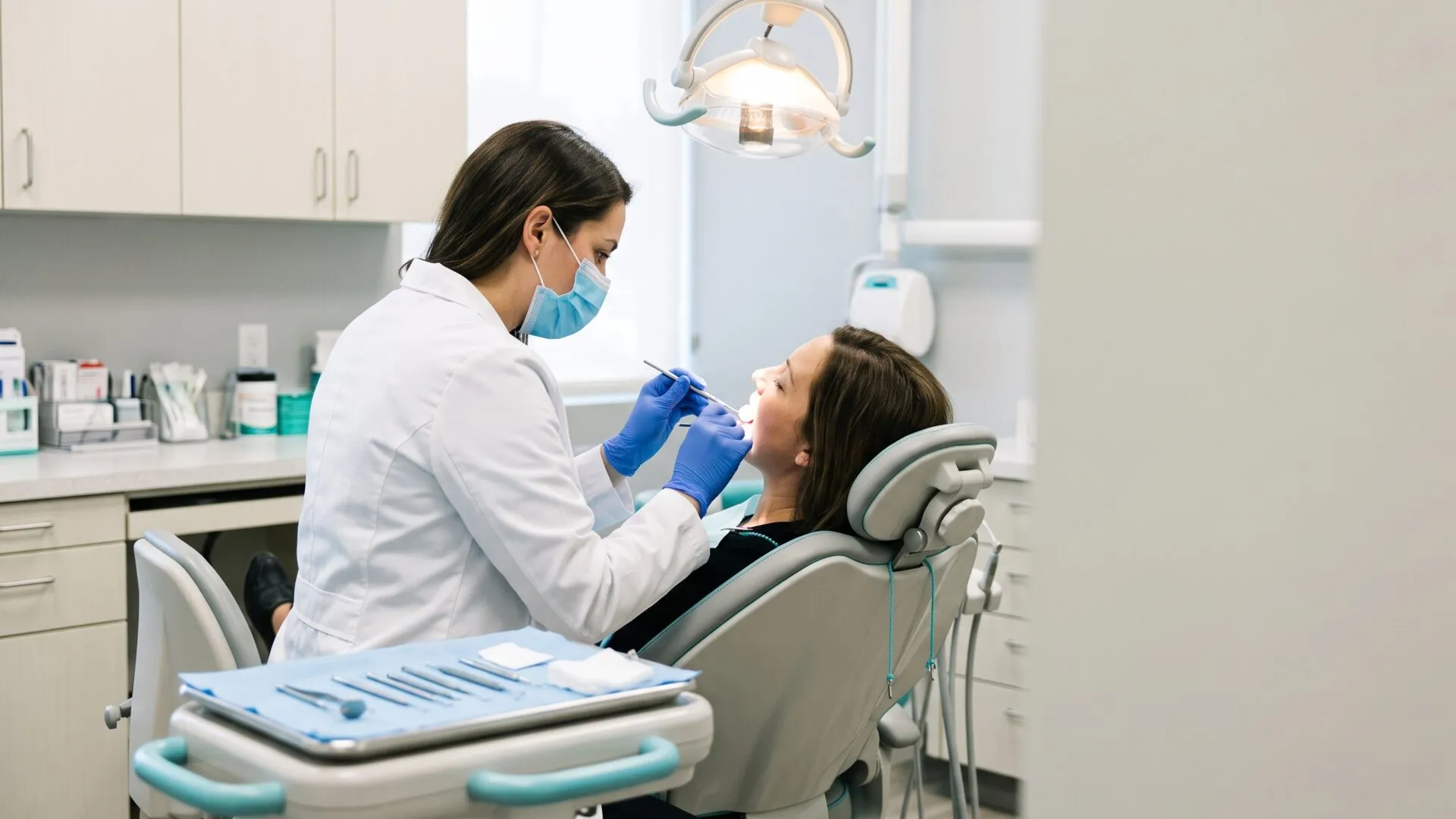
The dentist checks each tooth for decay, cracks and failing fillings, measures the gums for pocketing and bleeding, and looks at how your teeth meet when you bite. Existing crowns, bridges and implants are inspected too, because restorations tend to fail quietly rather than painfully.
X-rays
X-rays show what an examination cannot: decay between the teeth, the bone level around the roots, infection at a root tip, and unerupted or impacted teeth. They are taken when there is a reason to take them rather than automatically at every visit — how often depends on your decay and gum-disease risk, and your dentist should be able to say why this particular one is being taken. Digital sensors, now standard in most Lahore clinics, use markedly less radiation than the film they replaced.
Professional Cleaning
Scaling removes the hardened tartar that brushing cannot shift, and polishing smooths the surfaces afterwards so plaque re-forms more slowly. In Pakistan this is normally done by the dentist: the separate hygienist role that American and British articles describe is not an established part of most practices here, which is worth knowing so you are not caught out by who does it.
What Does Postponing Dental Care Actually Cost?
- A simple filling costs significantly less than a root canal and crown.
- Treating early-stage gum disease is much simpler than managing advanced periodontitis.
- Preventative care helps maintain your natural teeth longer.
Don't wait until you're in pain to see your dentist — by the time a tooth hurts, the cheap version of the fix has usually passed. Schedule your next check-up, tighten up the routine between visits with our guide to daily oral hygiene, or read about our general dentistry and preventive care services.